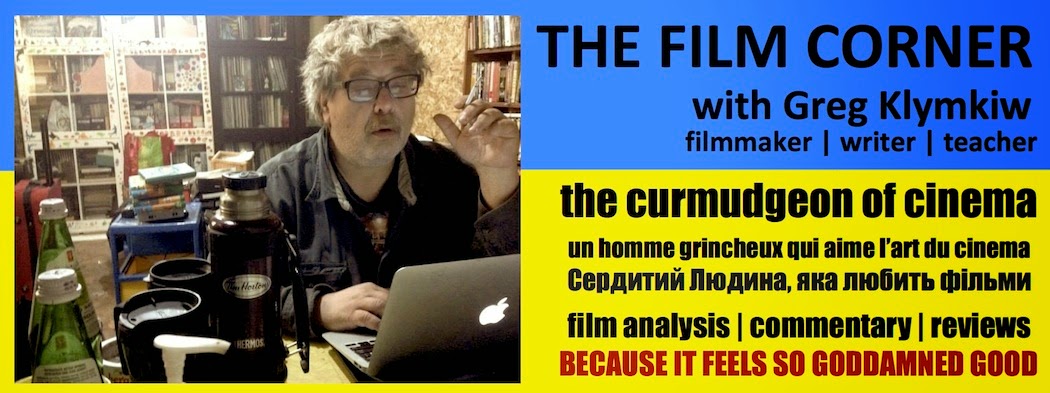
GREG KLYMKIW - THE CURMUDGEON OF CINEMA

ABOUT GREG KLYMKIW - un homme grincheux qui aime l'art du cinema: Greg Klymkiw’s 35 years in the movie business includes journalism, screenwriting, script editing, producing and 13 years of service to Norman Jewison's Canadian Film Centre as the senior creative consultant and producer-in-residence. In addition to producing iconoclastic work by Guy Maddin, Cynthia Roberts, Bruno Lazaro Pacheco and Alan Zweig, his legendary guerilla campaigns as the Winnipeg Film Group’s director of distribution and marketing placed prairie post-modernist cinema on national and international stages. In addition to Klymkiw Film Corner, he writes for POV, Phantom of the Movies' VIDEOSCOPE and among others, Electric Sheep - a deviant view of cinema. He's writing a book about screenwriting entitled "Movies Are Action" (featuring interviews with the world's best filmmakers). He is the subject of a documentary by Ryan McKenna entitled: "Survival Lessons: The Greg Klymkiw Story". At last count he had seen over 30,000 feature films.

GUIDE TO STAR RATINGS: ***** Masterpiece **** Excellent ***1/2 Very Good *** Good **1/2 Not Bad ** Whatever
*1/2 Poor * Raw Sewage . . . If a film is not quite up to earning a 1/2 star or 1 star, it will earn at least 1 Pubic Hair.

Sunday, January 15, 2012

BUG - Collaboration with playwright Tracy Letts yields homerun for William Friedkin, director of The Exorcist, French Connection & Cruising


Bug (2007) dir. William Friedkin
Starring: Ashley Judd, Michael Shannon, Harry Connick Jr.

***1/2

By Greg Klymkiw

Without question, Bug is one of the most compelling, terrifying and compulsively watchable pictures to grace the screen in quite some time. Directed by William Friedkin, that venerable master of all that can be deliciously and artfully nasty-minded in cinema, it is a picture that some might even view as a bit of a comeback for the filmmaker who unleashed, among many others, The Exorcist, The French Connection and Cruising. I am, however, not all that fond of the notion of comebacks – especially as they relate to men of Friedkin’s talent and vision – as Norma Desmond said, “it’s the pictures that got smaller”, and certainly in the case of Friedkin, the motion picture industry and the marketplace itself has changed, and certainly not for the better.

Bug tells the seemingly simple tale of a lonely working class woman (Ashley Judd) who finds a glimmer of happiness with a mysterious handsome stranger (Michael Shannon), only to be drawn into his web of paranoia. By finding love, they also discover pain, and eventually true happiness proves to be as elusive and delusional as their respective and, finally, collective states of mind.

In the end, does this really sound that simple? To be frank, it isn’t. In fact, one almost wants to avoid lavishing too much (or even any) attention to the plot since, for most of the picture’s running time, Bug careens madly into very dangerous and surprising territory. So surprising, in fact, that one of the minor disappointments is that the script by Tracy Letts (from his play of the same name) veers into some not-so-surprising territory in the last third of the picture’s running time.

However, for the first two-thirds of the picture, one never really gets a handle on where it is going. And in an age of cookie-cutter story telling, being surprised with every turn is not only rare, but in the case of Bug, supremely engaging and, even during some especially stomach-turning moments, entertainment of the highest order.

Friedkin is responsible for so much of this. Based on a theatrical piece, the movie wisely does not betray its roots but enhances them in a wholly cinematic way. Since most of the picture involves two people (with a handful of occasional “interlopers”) in one motel room, this could have (in less capable hands) been a dull, dreary mess. Friedkin keeps us glued to the screen with a keen eye that makes every shot a pleasure to look at, but also resonating with dramatic intensity. Not that the style is intrusive or obvious – it is, in fact, a delicious bird’s eye view of two people spiraling into a pit of insanity presented with verve and honesty.

This should come as no surprise to Friedkin followers. His early career as a documentary filmmaker in addition to his years of experience as a visual storyteller serves him very well. He has also adapted theatre to the big screen – most notably with the slightly dated, but still groundbreaking motion picture of Mart Crowley’s play The Boys In The Band. Friedkin is not one of those filmmakers who fall into the cliché of having to unnaturally “open up” a theatrical work and/or gussy it up with overly fussy visual details. Friedkin embraces the proscenium in a variety of inventive ways – preserving the claustrophobic intensity of the piece, but allowing it to still breathe as a work of cinema.

But perhaps Friedkin’s greatest gift as a storyteller is his audacity. When necessary, he will push the boundaries, up the ante and shove us headfirst into territory that most filmmakers who prefer to hide from or even worse, try to mute. Not Friedkin. He ‘rub our noses’ in the worlds of his various films and succeeds admirably.

Can anyone forget how far Friedkin took us in The Exorcist? Developing compelling characters and charting their journeys with the precision of a master documentarian and slowly building to a series of crescendos in which he earned and flung all manner of visceral atrocities in our face. Friedkin ensured that The Exorcist would be a true classic with lasting value by never forgetting that movies are a rollercoaster ride and that one must build to the peaks and valleys of terror with skill and precision to make sure that the moments of viscera stay with us forever.

With Cruising, Friedkin blended the tried and true ‘policier’ with a descent into a sexy, thrilling, Bosch-like world of gay S&M clubs. Some found this offensive and/or homophobic - too bad for them. They lose. It was supposed to be thrilling. And so it was.

And in The French Connection who can ever forget the moments of utter terror behind the wheel of Gene Hackman’s speeding car as it tore through the grubby, crowded streets of New York in pursuit of a train?

With Bug, Friedkin takes us on an equally compelling rollercoaster ride. As thrilling and memorable as the ride is, there is a point in the story where one gets a nagging feeling that it could go in a certain and potentially ho-hum direction, but because the picture has been surprising you all along and because the ride has been so happily infused with style, you repress your doubts and believe it will go into more unpredictable directions. The ride continues and it is still thrilling, but the eventual outcome was what you will, no doubt, have predicted at that earlier juncture. This is a bit of a drag.

But no matter: there are so few movies around these days as provocative and stunningly directed as Bug that one can forgive a flaw that would sink most other pictures.

The performance Friedkin coaxes from a slightly de-glammed, but still delectably sexy Ashley Judd is a tour-de-force – ranging from shy submission to out and out over-the-top insanity. Michael Shannon has had plenty of time to perfect his performance as the paranoid war vet on the stage, but he seems as fresh as if he were doing it for the first time. And in a supporting role as Judd’s psychotically abusive ex, Harry Connick Jr. shocks and surprises with a performance that is as sexy as it is terrifying.

Bug is a must-see motion picture. Even if you end up hating it, you’ll probably admire it anyway for both audacity and Friedkin's relentless directorial virtuosity.

CLICK HERE ENJOY THIS CLIP FROM "BUG"

Saturday, January 14, 2012

THE KILLER SHREWS - A Son of the Pioneers not only became "Festus" on GUNSMOKE, but produced this movie!!!


The Killer Shrews (1958) dir. Ray Kellogg
Starring: James Best, Ken Curtis, Ingrid Goude

***

By Greg Klymkiw

Ken Curtis is known to most of us for his long and distinguished career as an actor – from his musical appearances with the magnificent Sons of the Pioneers in numerous John Ford westerns (including his immortal turn as the guffawing clodhopper in The Searchers) to his long-running role as "Festus" the town drunk in the legendary TV western Gunsmoke. These achievements surely pale in comparison to the cherry on the chocolate fudge sundae that is Ken Curtis’s career - he was also the visionary producer of The Killer Shrews.

This extremely entertaining B-movie begins with extremely portentous narration informing us that shrews are nasty little beasts. If we take these scientific facts to heart, it appears that shrews put Hannibal Lecter’s (and presumably Robert Pickton’s) piggies to shame. From here we are plunged onto the bargain basement Dr. Moreau-like island where shrews have been bred all big and nasty by some mad scientist types. It's never explained why they choose shrews for their nefarious attempts at playing God, but one supposes we must take the aforementioned narration as reason enough.

The island is populated by a wide variety of local natives (shrew-fodder), a babe and a villainous heavy (played by Curtis himself). They eventually encounter a stalwart sea captain and his Stepin Fetchit-like sidekick who come to sniff out the dirty doings in this tropical paradise.

Much of the plot, such as it is, revolves around the captain trying to put the make on the babe who is inexplicably involved romantically with the seemingly psychotic Ken Curtis while shrews attack the inhabitants of the island.

As this movie clearly pre-dates CGI, the killer shrews are enterprisingly rendered by utilizing dogs with stringy mops affixed to their backs and huge vampire beaver teeth gaffer-taped and/or glued to the insides of their mouths.

I dare Industrial, Light and Magic to beat that!

The movie is surprisingly replete with thrills and they're reasonably genuine. This is no surprise as the proceedings are directed efficiently by famed special effects man and second unit director Ray Kellogg (making his directorial debut here). Let’s not forget that Kellogg was hand-picked years after this film by John (Our Father) Wayne to direct The Green Berets.

Then again, perhaps we DO want to forget that.

You will not, however, want to forget The Killer Shrews.

I dare you to try.

Legend Films has released “The Killer Shrews” in a terrific DVD that features a delightful bevy of special features including a terrifically colorized version, the original black and white version, some oddly amusing factoids on shrews, a bunch of period trailers from B pictures, an astounding 50s educational film titled “Squeak the Squirrel” and an entire second feature in a double bill (the incredibly lame “Giant Gila Monster” which is of interest only as the second Ken Curtis – Ray Kellogg collaboration).

12/30/07

Friday, January 13, 2012

THE SWELL SEASON - Lovebirds of ONCE make beautiful music together in new documentary about their concert tour wherein they fall sadly out of love.


The Swell Season (2011) dir. Nick August-Perna, Chris Dapkins & Carlo Mirabella-Davis
Starring: Glen Hansard and Markéta Irglová

***
(**1/2 if you hated the movie Once, *1/2 if you hated the music too)

By Greg Klymkiw

Music is the tie that binds. It's also a universal language - kind of like love. Glen Hansard and Markéta Irglová starred in the huge independent hit movie Once. Written and directed by John Carney, shot on tape for almost zero dollars over a three-week period in 2006, the movie went on to become a multi-million dollar grosser, a prize-winner at Sundance and even more miraculously, copped the 2008 Oscars for Best Achievement in Music Written for Motion Pictures and Best Original Song ("Falling Slowly").

Its stars (who triple-played as singers and composers) were complete unknowns. Hansard had been a busker in Dublin for years and Irglová was a recent immigrant from the Czech Republic. The movie was a delicate love story between two characters who, through a chance meeting on the streets of Dublin, become musical collaborators. As the movie progresses, the characters eventually fall for each other and the songs they write chart their ever-deepening love.

The movie almost sickened me. "Almost" is the operative word. In spite of its twee whimsy, I was, by the end of the movie, sold on its strange, unique (albeit earnest) beauty and that damn song "Falling Slowly" was rooted in my brain for much longer than I would want it to be.

The movie itself and the tale of the movie's success are both Cinderella stories. The story of what eventually happened to Hansard and Irglová is charted in the new documentary The Swell Season and while the Cinderella story continues, it comes to a most unhappy ending.

The movie follows the singer-composers, separated by almost 20 years in age, as they begin a worldwide tour with their band "The Swell Season". The two had actually fallen in love and during the first half of the movie, as we see them rehearse, play huge concerts, kibitz backstage, spend quiet time together and visit with their respective families. They definitely seem joined at the hip in ALL respects and most importantly, it's clear how deeply in love they are. The second half of the movie takes a tragic turn. In this sense, the filmmakers were really lucky, since I suspect a straightforward concert film of these two might have proven pretty intolerable for anyone but their most diehard fans.

The toil of the road, their age difference and a very affecting personal tragedy all contribute to their relationship falling apart in every respect - other than their symbiotic MUSICAL relationship.

It's definitely an interesting and watchable movie, especially for anyone who loved Once, but the filmmaking is competent at best and as an exploration of a musical subject, it certainly lacks the extraordinary power of something like Paul Williams Still Alive - a picture with an astoundingly dynamic subject and directed with genuine filmmaking savvy and artistry. The Swell Season attempts to mask its competence by presenting the movie in monochrome tones, but this seems a bit more pretentious rather than being appropriate. That said, the tones work whenever we focus on Hansard and his very strange family.

What seems odd is that the movie presents very little of Irglová's family and background, placing most of the emphasis on Hansard. Perhaps he just seemed more interesting to the filmmakers or, as I suspect, Irglová simply doesn't have Hansard's depth of life-experience as she displays in some of the latter "argument" scenes. For me, Hansard seemed like the voice of reason and a true artist, while Irglová felt a bit like a modest talent who stumbled into something a bit over her head - aesthetically and emotionally.

Luckily and happily, as with any movie (especially one that is shot mostly hand-held), the sound is first-rate and seeing the movie on a big screen with a great audio system would be a real pleasure.

In this sense, The Swell Season is a Cinderella story of two solitudes.

"The Swell Season" is currently in theatrical release. In Canada, the film is playing at two exquisite independent venues, The Royal Cinema in Toronto and Vancity in Vancouver and is being released via Mongrel Media.

A DANGEROUS METHOD - Cronenberg's boring Masterpiece Theatre episode of "Jung and the Art of Spanking" is now in theatrical release. Please avoid it!


A Dangerous Method (2011) dir. David Cronenberg
Starring: Michael Fassbender, Viggo Mortensen and Keira Knightley

*

By Greg Klymkiw

When David Cronenberg is good, he is very, very good.

When he is bad, he’s cerebral.

A Dangerous Method is dour, dull and decidedly humourless. That said, the first few minutes do suggest we’re in for a hootenanny of the highest order. The score, oozing with portent over a twitching, howling, clearly bonkers Keira Knightley, thrashing about in a horse-drawn carriage as it hurtles towards Carl Jung’s Swiss nuthouse, initially suggested a belly flop into the maw first pried open by such Cold War wacko-fests like The Snake Pit or Shock Corridor.

Alas, Cronenberg seems to have abandoned his pulp sensibilities and instead appears to be making an Atom Egoyan movie fused with Masterpiece Theatre. Sorry David, Atom Egoyan makes the best Atom Egoyan movies. And Egoyan has never, nor will he ever make Masterpiece Theatre. However, if Cronenberg himself genuinely fused Masterpiece Theatre with The Snake Pit and, say, Salon Kitty or The Story of O, with dollops of the madhouse scenes in Ken Russell's The Music Lovers, then he might have generated something not guaranteed to induce snores.

Cronenberg’s unwelcome return to the cold and clinical approach from his pre-Eastern Promises and A History of Violence oeuvres quashes all hope for a rollicking good wallow in lunacy.

Come on, David, we’re dealing with psychoanalysis and sex here.

A little oomph might have been in order. (Or as Norman Jewison is wont to say, "A little bit of the old razzle-dazzle.")

Lord knows Cronenberg’s dealt deliciously with psychoanalysis and sex before – most notably in The Brood. It starred a visibly inebriated Oliver Reed, crazily cooing about "the Shape of Rage" amid spurts of horrific violence laced with a riveting creepy tone. Most notably the movie provided us with the indelible image of a semi-nude, utterly barmy Samantha Eggar adorned with monstrous pus sacks dangling from her flesh, licking globs of gooey, chunky afterbirth from a glistening mutant baby expunged from one of the aforementioned pus sacks.

Now, THAT'S entertainment!

Annoyingly, no similar shenanigans are on view in A Dangerous Method. It’s pretty much a Masterpiece Theatre-styled period chamber drama with with Carl Jung (Michael Fassbender) jousting with his mentor-rival Sigmund Freud (Viggo Mortensen) betwixt spanking sessions with Keira Knightley, a daft want-to-be-psychiatrist with Daddy issues.

Sadly, no proper views of open palms connecting with buttocks or slap imprints on said buttocks are afforded to us.

A pity.

Thursday, January 12, 2012

DELIVERANCE - John Boorman delivered one of the truly great American films of all time. It took aesthetic risks and very REAL risks. It was, frankly, dangerous - REALLY dangerous - to make this movie. REAL men in REAL canoes on a REAL river - A REALLY FUCKING DANGEROUS RIVER.


Deliverance (1972) dir. John Boorman
Starring: Jon Voight, Burt Reynolds, Ned Beatty, Ronny Cox and Bill McKinney

****

By Greg Klymkiw

In this day and age, is it possible to imagine a filmmaker assembling a cast and crew willing to risk life and/or limb to make a movie? Not just any movie, mind you - I'm talking about a movie of such importance that rendering it properly would be so fraught with peril that the production company would never be able to secure anything resembling insurance.

Furthermore, would one be able to find in today's landscape a financier with the balls to green-light a movie so dangerous to its participants that the picture and the very act of making it would seem, to any reasonable individual, a completely irresponsible act? In an industry increasingly ruled by lawyers, accountants, insurance agents, frail, sensitive actors and their weak-kneed handlers and worst of all, powder-puff movie executives and administrators who can only do business by dotting all the "I-s" and crossing all the "T-s" , my answer to the abovementioned questions would be a pure and simple, "I think not". (Though a recent exception to this rule might be Tom Cruise's insane stunts in Mission Impossible: Ghost Protocol, though the movie itself is hardly a risk-taker in any other sense of the word.)

That anyone would risk ANYTHING to make a movie at all these days seems to be a rare occurrence and with the lack of risk-taking at all levels of the industry, I sincerely doubt John Boorman's stunning adaptation of James Dickey's novel Deliverance would even be made today.

Well, I suppose it would and could be made in today's climate of caution, but it would be awful, or at best - not nearly as good - at least not if it was made with the sort of punch-pulling, namby-pambiness that renders most everything these days as inconsequentially trite. Most pictures - especially today - will choose to use a battery of stunt men to take the places of actual actors engaging in acts of derring-do, while digital effects would make up for being able to take the time, trouble and decidedly risky business to actually capture on film those said acts of derring-do.

One of the many things that contributes to the greatness of Deliverance is that we see real men in real canoes on a real (and really fucking dangerous) river. In fact, when I used the Blu-Ray technology to scan the more insane stunts, I was only able to detect one - COUNT 'EM - one instance where a stunt man was used.

And I was right - when I scanned through the generous extra features on the recently-released Warners Blu-Ray disc, my own findings were corroborated.

With Deliverance, what we see is what we get - four great actors risking their very lives to make this movie. The film is packed with several terrifying instances of this, but two of them stand out.

The first is when a characters's canoe turns over on the raging waters and he cascades over a rocky indent and plunges in such an awkward manner that the CHARACTER breaks his leg. Watching the actor in question during the aftermath as he is carried along by the current, the pain on his face is so palpable that when it's finally revealed that his bone is actually jutting out of his thigh, there's no doubting his pain. While the actor in question didn't break his leg for real, he did, in fact, break his coccyx. The pain we witness is not only "in character", but it is real.

The other terrifying moment is witnessing one of the characters scaling a huge, treacherous rock cliff. It's an extremely harrowing scene and even more so when you start to realize that this is the actual actor scaling the actual cliff. To say this enhances the drama would be an understatement. (And never mind the actor - think of the camera people and director who would have been dangling perilously with the actor to capture these harrowing shots.) Narratively, his goal is one of life and death. If he does not accomplish his mission, everyone in the party is lost - therefore, the narrative importance of making this real cannot be underestimated.

And why, you ask, is the character scaling this cliff armed with a crossbow gun? And just who is the grizzled, toothless psychopath waiting at the top with one mean-ass shotgun Well, by now, only those living on the moons of Jupiter DON'T know what Deliverance is about.

Briefly then, for the Jupiter-Moon-dwellers, four city slickers take a weekend canoe trip along a raging river in the deep South that will soon be flooded and consumed by a huge, man-made lake. When they are attacked by crazed hillbillies with a penchant for forcible sodomy, they must not only survive the perils of nature, but dig deep to discover their dormant savage nature and defend themselves at all costs. It's pure and simple and through that purity and simplicity, the filmmakers have delivered an astoundingly rich and complex work.

With his novel, the late, great American poet James Dickey used this simple narrative coat hanger to explore man's relationship to nature and his inner beast. Director John Boorman pushed the simple narrative further to explore the notion of the effects of man playing God and the results of trying to beat and/or control nature. Clearly a perfect creative team, Dickey (who also wrote the screenplay adaptation) and director Boorman, successfully collaborated on a movie that thrills us viscerally and engages us intellectually and finally, just plain scares the shit out of us.

And to reiterate, it's not just the action and suspense that grabs us. The characters are perfectly etched and rendered. The four motley city slickers are a typical mixed-bag, not just for the drama, but are, like life itself, a microcosm of people we all know - including, perhaps, ourselves.

Lewis (Burt Reynolds) is Mr. Macho Man - he loves nature, he loves danger and he's as gifted in traversing raging white water as he is with using a cross-bow to secure their food and, eventually, to defend themselves against the toothless, drooling, inbred, sodomy-loving hillbillies (Bill McKinney and Herbert "Cowboy" Coward).

Ed (Jon Voight) is, by default, a rugged-enough hunk, but he has suppressed his true nature so long that it takes quite awhile to find the way back to manliness.

Drew (Ronny Cox) is a guitar-picking, folk-singing bleeding heart Liberal who also gets to be part of a scene that has already - among several in this movie - become indelibly etched on the memory banks all who see it. Drew is front and centre of the "duet" sequence involving the traditional backwoods song "Dueling Banjos".

And last, and certainly not least, Bobby (Ned Beatty) is a jovial, ribald, bumbling fat man who suffers the most savage indignity and learns to "squeal like a pig" in a scene that is so horrific that it's both painful to watch and unforgettable.

These four men are strange bedfellows, but it's their very differences that make them a good team and ideal company for each other.

Boorman attacks the material with both intelligence and ferocity. Supported by the stunning location photography of the brilliant Vilmos Zsigmond, Deliverance is a movie that knocks you on your ass the first time you see it and is so exquisitely rendered that repeat viewings never disappoint. The picture continues to creep you out, thrill you and stimulate the old brain juice - again and again and again.

Another astonishing thing about Deliverance is that its stylistic and storytelling techniques are not dated. It feels as fresh and vibrant today as when it was made back in 1972. On one hand, it is a product of its time in that it explores such dangerous territory unflinchingly, but aside from some big-ass old cars that nobody drives anymore, it feels like it could have been made yesterday.

Finally, that's what renders it a classic. There's nothing ephemeral about this movie.

It is a picture for now and forever.

And that's why it's a masterpiece.

"Deliverance" is available on Blu-Ray from Warner Home Video. It's an astounding transfer that happily and wisely does not attempt to blunt the raw quality of Zsigmond's photography which, by the way, has some of the finest day for night work in cinema history. On HD, it's as stunning as it was when I first saw it on a big screen in 1972.

12/13/09

Wednesday, January 11, 2012

THE MAJOR AND THE MINOR - Romantic Comedy with pedophilic overtones. Made in Hollywood. In 1942. 1942? Well, it IS Billy Wilder's directorial debut.


The Major and the Minor (1942) dir. Billy Wilder
Starring: Ginger Rogers, Ray Milland, Robert Benchley, Rita Johnson and Diana Lynn

****

By Greg Klymkiw

“Why don’t you step out of that wet coat and into a dry martini?”

Ever hear (or use) that one before? (Or variations on that theme?)

Well, thanks to screenwriters Billy Wilder and Charles Brackett, the abovementioned come-on line from their wickedly diseased minds splashed onto celluloid in 1942’s “The Major and the Minor”, Wilder’s debut in America as a director.

Though filmmakers during this period had to deal with significant censorship because of the restrictive production code, Wilder managed to make movies that flouted the code persistently by brightly and fiercely presenting all manner of permissiveness in a multitude of new and exciting ways. With “The Major and the Minor”, Wilder would pull some rather substantial wool over the eyes of the Code – and what magnificent wool-pulling it proved to be!

The picture features saucy, sexy, vivacious Ginger Rogers as small-town girl Susan Applegate who tries – rather unsuccessfully – to make a go of it in the concrete jungles of New York. Tired of all the wolves that want just one thing (and one thing only – right fellas?) from her supple self, she’s compelled to beat a hasty retreat back to middle America after the abovementioned martini line slithers out of the slavering mouth of horny reprobate Albert Osborne (Robert Benchley). Osborne refuses to take “no” for an answer - insistently endeavoring to get into Susan’s panties. She is forced to resist in a manner that betrays her almost veteran-like stature in having to expertly rebuff similar unwanted amorous advances.

Once at the train station to escape the dogs, as it were, of New York, she realizes she is short a few dollars for the ticket back home and gets the idea to do a makeover (pigtails, lollipop, balloon, etc.) to qualify for a child’s discount ticket. The ruse gets her a ticket, but once on the train, she’s pursued by some skeptical conductors and finds herself hiding in the compartment of a handsome young officer, Major Phillip Kirby (dashing Ray Milland). The Major takes an instant liking to this lollipop-licking “12-year-old” (who, befitting her pre-teen “age”, is referred to as “Sue-Sue” rather than “Susan”) and in an initially innocent, fatherly way Kirby becomes Susan’s saviour and benefactor – not only securing her safely on the train, but temporarily putting her up at his fiancé’s family estate.

It is here, amongst high society, where Lucy (Diana Lynn) a real 12-year-old (and little sister to Phillip’s fiancé) engages in sibling rivalry in extremis and helps Susan steal Phillip’s heart from her nasty, cold fish older sister. And it is also here that amongst the upper crust where the Major disconcertingly appears to be falling in love with a 12-year-old girl.

We, the audience, have had no doubt the Major would fall for Susan, but it starts getting just a little bit strange that the charade continues quite as long as it does. Yes, Susan knows she’s 30 and we know she’s 30 and Lucy knows she’s 30, but the Major most certainly does NOT. In fact, as he’s a teacher of young military cadets, he even seems to be setting his “Sue-Sue” up with any number of his students. He seems to be downright pimping Susan – perhaps to quell his own feelings for her.

Amusingly, but also tellingly, Susan – once the recipient of unwanted attentions from much older men (when she “was” 30) is now, at the age of 12 being hounded by young teenage boys.

On the surface, The Major and the Minor seems to be as frothy and inconsequential a romantic comedy as one is likely to experience. As the film progresses however, you realize it’s pure cynical Billy Wilder and while thoroughly bubbly, it’s not inconsequential in any way, shape or form. Substantially ahead of its time in terms of examining the sexual roles of men and women, and in particular, the way in which women are sexualized by men and society at practically any age, this proves to be a picture that does the requisite double duty of being entertaining and thought provoking all at once.

Finally, one of the more interesting aspects of this picture in terms of how women are viewed by men and by society at large is the fact that Susan is not – even for a moment – a convincing 12-year-old to the REAL 12-year-old and, in actuality, often acts far more immature than a 12-year-old actually would. The fact that a grown man AND teenage boys STILL seem attracted to this 12-year-old who might actually be younger or, at the very least, MORE immature seems to suggest the pedophilic nature inherent in ALL men.

The Major and the Minor” is an extraordinary picture. It’s funny as hell and even romantic, but it’s also super-creepy. Some might suggest the creep factor was not Wilder’s intent, but one only needs look at his subsequent work (“Double Indemnity”, “The Apartment”, “Sunset Boulevard”, etc.) to realize that there’s no reason why it would NOT be intentional.

Wilder was nothing if not provocative. Watching this movie and comparing it to contemporary want-to-be provocateurs like Todd Solondz and his ilk, it becomes especially apparent how ahead of the pack Wilder was – ahead of the pack, ahead of his time and, to a certain extent, ahead of our time also. Wilder was and is, in fact, the real thing, while those who try to do the same thing now in their insufferably hip fashion are not much more than poseurs. Wilder is definitely a major. Most of the rest are minor.

“The Major and the Minor” is available on DVD from Universal Studios Home Entertainment.

7/18/08

Tuesday, January 10, 2012

DR. CYCLOPS - Fun addition to work of great fantasy-adventure director Ernest B. Schoedsack


Dr. Cyclops (1940) dir. Ernest B. Schoedsack
Starring: Albert Dekker, Thomas Coley, Janice Logan

***1/2

By Greg Klymkiw

The director of Dr. Cyclops, Ernest B. Schoedsack, had a life that rivaled the adventures experienced by many of the characters that populated his motion pictures.

At the age of 12, Schoedsack ran away from home. By the age of 17, he was a motion picture cameraman for the legendary comedy producer Mack Sennett. At the tender age of 23, he joined the signal corps as a cinematographer and spent much of World War I in the thick of the most horrendous battles, photographing their every detail. After the armistice was signed, he paired up with another young adventurer (Merian C. Cooper) and the two of them became involved in the anti-Bolshevik movement in Russia, Ukraine and Poland.

And this was all before he became the groundbreaking director of some of cinema’s greatest adventures.

While it’s not necessary to know the breadth of Schoedsack’s considerable life experience in order to enjoy his motion pictures, there’s something that’s both moving and admirable to know that adventure fantasies such as King Kong, The Four Feathers, The Last Days of Pompeii and The Most Dangerous Game came from an imagination that was tempered with having seen and done so much as a young man. Schoedsack’s work is imbued with a sense of wonder, adventure and, most importantly, exploration. What’s especially amazing about Schoedsack’s work on Dr. Cyclops is realizing that it was made in 1940.

1940!!!

Schoedsack, endowed as he was with a great eye and a knack for special effects was – to put it mildly – one hell of a photographer and filmmaker. His work in this picture laid the visual groundwork (as Kong most certainly did) for generations of films and filmmakers to follow.

Dr. Cyclops is the fun and thrilling tale of a truly mad scientist (deliciously and brilliantly portrayed by the bald and coke-bottle-lensed Albert Dekker) who uses radium to shrink people and animals alike in a crazed attempt to rule the world. The picture not only features staggeringly gorgeous three-strip Technicolor photography, but a variety of eye-popping special effects that, for their day, would have knocked people on their buttocks and which are, even by today’s standards, quite magical.

The heroes and heroines of the piece pale, of course, beside the tragically obsessive central character who is both literally and figuratively blinded – as the title even implies – but this too is par for the course in a sci-fi melodrama on the scale of this one, and while familiar, it fits comfortably like a comfy, old sweater.

Dr. Cyclops is not the masterpiece that King Kong was, but in its own special way, it was definitely ahead of its time in terms of both special effects and political/historical considerations and it amply provides solid entertainment to anyone who loves genre pictures. The picture’s exploration of a “foreign” enemy wanting to experiment upon and ultimately subjugate American interests also pre-dates that attitudes so prevalent over one decade later during the sci-fi pictures made during the Cold War.

“Dr. Cyclops” is a most welcome addition to the second volume of Universal’s magnificent DVD box-set entitled The Classic Sci-Fi Ultimate Collection. It’s a gorgeous transfer of a fine little picture and while it’s certainly worth renting, the price point on this box is so reasonable that fans would be well advised to just buy it.

6/4/08

Monday, January 9, 2012

THE NEW CENTURIONS - Richard Fleischer's screen adaptation of former LAPD cop Joseph Wambaugh's first bestselling novel delivers a dramatic, but realistic front-lines approach to a world that most of us couldn’t even begin to imagine.


The New Centurions (1972) dir. Richard Fleischer
Starring: George C. Scott, Stacy Keach, Jane Alexander, Clifton James, Scott Wilson, Erik Estrada, Rosalind Cash, Isabel Sanford, James Sikking and William Atherton

***

By Greg Klymkiw

It’s always a pleasure to extol the considerable virtues of Richard Fleischer, one of the most overlooked and underrated American directors, even when the picture in question is not one of his best works. The New Centurions is a movie that, at least for me, plops squarely into the category of work I loved as a kid that hasn't held up as well as I’d hoped. That said, it has much to recommend it – most notably, a great George C. Scott performance and a generally fine first two-thirds. If there are major problems with the film, they probably lie with Stirling Silliphant’s erratic screenplay adaptation of Joseph Wambaugh’s groundbreaking, best-selling novel.

Wambaugh is, of course, the former LAPD cop-turned-novelist whose books captured the day-to-day grind of police life sans shoot-em-up glorification – a dramatic, but realistic front-lines approach to a world that most of us couldn’t even begin to imagine. Fleischer’s movie version, from a directorial standpoint, often does an excellent job in this respect. Taking us from the graduation of rookie cop Roy Fehler (Stacy Keach) and his on-the-job training under the tutelage of grand, old man of the force; the wizened, cynical Andy Kilvinski (George C. Scott), a good part of this journey offers considerable entertainment value. With the dark grainy lighting and camerawork of Ralph Woolsey, Fleischer gets us through the nightly grind of patrol cops in an almost documentary-like flavour.

For the most part, this is no standard-issue genre fare as we follow the cops on a series of almost mundane adventures – domestic disputes, child abuse cases, petty theft, grifting and in one of the movie’s more amusing segments, the rounding up of streetwalkers, shoving them into the back of a paddy wagon and getting them boozed up so they can’t ply their trade. The film also focuses on the cops’ bouts with alcoholism and marital strife. All of this is peppered with George C. Scott's Kilvinski who regales his rookie charge with all manner of crusty wisdom and gallows humour.

For 1972, this was certainly groundbreaking material.

My first helping of the picture was at the tender age of 12 and I saw it with my ex-cop Dad. As a movie, it was definitely unlike the usual father-and-son fare in the de-glamorization of the cops’ lives and I also recall my own father responding very positively to the movie in that it had “less bullshit” than other cop pictures. Seen now, though, it’s a movie that scores points for being the first of its kind in the mainstream, but alas, loses considerable steam as Silliphant’s script maintains the episodic structure of Wambaugh’s book without finding a compelling enough backbone to hang it on cinematically. The script also adds, all on its lonesome, clunky and clichéd verbiage in strange contrast to the dialogue that crackles as well as plot elements that feel too stock.

This seems especially odd since Silliphant did such a fine job adapting the classic cop novel on which Norman Jewison’s In The Heat of the Night is based. With that film, Silliphant was able to deftly sift the best and most cinematic elements in the original source material by John Ball, while adding the proper connective tissue to make the picture a cohesive whole. The New Centurions by comparison is messy, lurching from one episode to another and never quite capturing the sense of time passing in a smooth manner.

There are other problems with the picture. When the character of Kilvinski tragically departs from the story, the rest of the movie can’t quite rise to Scott’s level of performance and his presence, or lack thereof in the latter third. Scott's rendering of this character is so powerful it almost seems like movie’s only raison d'être.

Alas, the marital difficulties portrayed border on soap opera. It's bad melodrama, pure and simple. It doesn’t help that actress Jane Alexander portrays Stacy Keach’s wife with such ramrod-like seriousness that she comes off like a harridan on lithium. Equally unexceptional is a subplot involving the gorgeous Rosalind Cash as Keach's fresh love interest. In theory, both of these SEEM necessary, but feel shoehorned in to the proceedings rather than flowing naturally from them.

Even more bothersome is the rather interesting cast of supporting characters who are introduced, then dropped, with no visible effort to fully integrate them into the whole. Part or this is definitely a script issue, but in fairness to Siliphant, this and some of the other structural failings could well be coming from studio-imposed cuts to bring the movie closer to traditional cops n' robbers fare. (There is even a well directed, but completely out of place car stunt that feels like it belongs to another movie.)

All this said, though, Fleischer keeps the action moving with his typical efficiency and he works overtime to deliver a sense of the streets and the day-to-day aspects of police work. Some of the banter of the cops themselves (both on patrol and in the station house is gorgeously rendered. There are individual scenes and sequences that soar in spite of the screenplay's flawed structure. Some are simply unforgettable.

Scott’s rendition of “Kilvinski’s Law”, the character’s off-the-book sage advice, is a marvel to behold. Nobody but Scott could do full justice to nuggets like: "Treat everybody the same - white, black, brown. Be civil to everybody, courteous to no one. We're supposed to use equal force. If a dude uses his fists, you use your stick. If he uses a knife, you use your gun - cancel his ticket right then and there. If everything else fails, hit him with a brick."

Other fine moments include a terrifying scene where the cops rescue a baby from being burned and beaten by its neglectful mother, an especially hilarious sequence involving the entrapment of a seven-foot lumberjack “fruit” seeking manly amore in a local park and George C. Scott’s final monologue which is not only heartbreakingly performed, but one of the few moments that achieves what the whole movie aspires to.

Besides, where else is one going to see Mrs. Jefferson herself (Isabel Sanford) playing a foul-mouthed, fat-assed, soul-infused street whore? That gal definitely was “a movin’ on up”.

Oh, and have I mentioned the movie has one major-league groovy Quincy Jones score?

“The New Centurions” is available on DVD from Sony Pictures in their Martini Movies series.

10/12/08

Sunday, January 8, 2012

THE CULT OF THE COBRA - What is Lamia? 'Tis the head and breast of a woman… and the body of a… SERPENT!!! Now you know.


HAPPY UKRAINIAN BOXING DAY! Continuing the tradition of steering you towards awe-inspiring work in this season of goodwill, Greg Klymkiw's CFC presents a KLYMKIW FILM CORNER review of…

THE CULT OF THE COBRA
(Nothing to do with Ukrainians save for the fact that this review is written by a Uke.)


Cult Of The Cobra (1955) dir. Francis D. Lyon
Starring: Faith Domergue, Richard Long, Marshall Thompson, David Janssen

***

By Greg Klymkiw

While one cannot justify delivering more than two-and-a-half stars for this copycat of Val Lewton’s The Cat People, it is a rating that doesn’t adequately represent the picture’s considerable entertainment value and its extremely interesting commentary on post-war life in America, so screw it! I'm giving this thing three stars.

Cult of the Cobra is another film from Universal Home Video’s magnificent DVD box-set “The Classic Sci-Fi Ultimate Collection” and though it lacks panache (save for the terrific cinematography of Russell Metty), it represents just the sort of picture that home consumption appears to have been invented for – a medium to deliver product that might otherwise be consigned to a slag-heap of forgotten cinematic refuse. And for Cult of the Cobra, the fate of neglect would be a shame.

In spite of Francis D. Lyon’s perfunctory direction, there’s something extremely haunting about this story of a group of young American soldiers who have survived the horrors of war and yet, when the clouds of strife are lifted, find themselves stalked and cut-down on home turf by a mysterious, evil and (naturally) foreign killer.

While some contemporary audiences get all high and mighty in their idiotically myopic political correctness when it comes to the ethnocentrism of older pictures, they should just swallow a humour pill and enjoy the fact that the film begins in Asia. Yes, Asia! The film does not specify where EXACTLY in Asia we are – all that really matters is that we are not in AMERICA and that our brawny, normal, American and WHITE heroes are in a mysterious, foreign land. Foreign, in this context equals EVIL!!!!! And even though we’re supposed to be in “Asia”, we’re really in some crazed never-never-land of cloaked, turban-adorned snake charmers.

Looking for some exotic action before returning to their normal lives back in America, our motley heroes manage to buy their way into a mysterious ceremony of snake worshippers where they witness a boner-inducing cobra-charming burlesque routine then interrupt the proceedings in that brashly rude, American way when one of them snaps a flash photo and then, to make matters worse, they engage in a brawl with these foreigners and steal their sacred snake basket. One of the soldiers at a later juncture opines that perhaps they went a “little too far”.

You bet, fella!

These goddamn foreign snake charmers don’t take to your kind at the best of times and now you’re in for one kick-ass curse that’s not only going to follow your infidel rump back to the homeland, but to your ever-loving grave.

And believe you me, bud, there ain’t nothin' Homeland Security can do about cobra curses.

The cast and the vaguely derivative (but compelling) screenplay work overtime as the picture progresses. Things get especially entertaining when our soldier boys get back to America. We primarily follow the adventures of roomies Richard Long (the eventual star of TV’s Nanny and the Professor) and Marshall Thompson (eventual star of T.V.’s Daktari) as they vie for the affections of a wholesome platinum blonde apple-pie babe (Kathleen Hughes). When she eventually picks stalwart hunk Richard Long to be her swordsman, Marshall Thompson dejectedly finds himself in the arms of the mysterious, exotic and FOREIGN Faith Domergue. Domergue plays an agent of the cobra-worshippers and her mission is to kill each and every last one of the infidel soldiers.

By the bye, Faith Domergue represents everything that was so great about 50s movie babes – nice full lips, melt-in-your-mouth curves and sex appeal that never lets up. Domergue was especially semen-draining to young, pud-pulling male movie-goers in This Island Earth.

As per usual - especially when extolling the virtues of 50s babes - I digress.

Russell Metty, the cinematographer, especially delivers the goods. Metty, who shot most of Douglas Sirk’s great melodramas and, lest we forget, Orson Welles’s Touch Of Evil, contributes marvelous lighting and some really effective cobra POVs.

One only wishes that Francis Lyon wasn’t such a dull director. His lack of voice is what keeps this movie from really soaring. Lyon was a great editor (he won an Oscar for his astounding cutting on the classic boxing picture Body and Soul), but as a director, he plays things strictly by the numbers. This workmanlike approach is not always a bad thing in a director, but this picture is so entertaining to begin with that one wants it to be better than it is.

Alas, they can’t all be masterpieces. If they were, the world would actually be a dull place. It’s probably enough that the picture exists and that it’s as fun and interesting as it is. The strange post-war ennui afflicting all the soldiers on home turf and how the strangest element of their experience overseas follows them makes for compelling enough viewing - they've survived war, but those they've made war upon are with them - whether they like it or not. That there is a supernatural element which sinks its hooks into these men is damn evocative, in spite of the ho-hum helmsmanship of Lyon.

One does wonder, however, what the picture might have been like with a livelier directorial hand – a Jack Arnold, a Richard Fleischer, a Joseph Lewis or an Edgar Ulmer – or, for that matter, a producer like Val Lewton. In fact, any one of those directors and Lyon editing (instead of directing) might have delivered the goods.

It’s still a good picture though. Seeing these hunky, fresh-faced young soldiers get mysteriously whacked by the stunning Faith Domergue will keep you on the edge of your seat.

And, you know what? I’m almost inclined to revise my two-and-one-half to three-star boost yet another half-star in Heaven's direction.

I won’t, but one can dream, can’t one?

“Cult of the Cobra” is available on DVD in Universal Home Video’s “Classic Ultimate Sci-Fi Collection”

12/11/11

Saturday, January 7, 2012

MANDINGO - "Your wife craves for you to have wenches, son. Keeps her from havin' to submit."

-->

MERRY UKRAINIAN CHRISTMAS! Continuing the tradition of steering you towards awe-inspiring work in this season of goodwill, Greg Klymkiw's CFC presents a KLYMKIW FILM CORNER review of…

MANDINGO
(Yeah, I know. This has nothing to do with Ukrainians. Gotta problem with that?)


MANDINGO (1975) dir. Richard Fleischer
Starring: James Mason, Perry King, Ken Norton, Susan George, Paul Benedict

*****

By Greg Klymkiw

Receiving critical jeers upon its release in 1975, Richard Fleischer’s film version of Mandingo, adapted from Kyle Onstott's best-selling sex and slavery potboiler and produced by the oft-loathed-and-scorned producer Dino De Laurentiis, did, like its recent cinematic blood-brother Showgirls (Paul Verhoeven’s All About Eve in a Vegas strip club) achieve considerable cult status as a bright jewel in the crown of unintentional high camp and laughs.

I recall a critic in the long-defunct Canadian-published film magazine Take One (the 70s version, not the 90s reincarnation) bestowing a Mandingo “Please Don’t Whup Me No Mo’, Massah” Award for the Worst Film of the Year. Quentin Tarantino issued a laudatory misreading which placed it in the pantheon of stellar lower-drawer laugh riots like the abovementioned Showgirls. Golden-Turkey-styled attention was also lavished upon it when critic Stephen Rebello included Mandingo in his tome on “bad movies we love”.

In spite of all these uncalled-for raspberries, I assert - wholeheartedly and with NO reservations - that Mandingo is a genuinely terrific picture. It has been the recipient of boneheaded derision for too long, now, and this is a wrong that needs to be made right.

The source material, like many other great pictures (The Godfather, The Exorcist, Jaws – to name just a few), is derived from a trashy, mega-potboiling novel. Mandingo was first published in the 50s and not only went through the roof on its initial release, but also continued through the 60s and 70s to be a huge seller – receiving countless reprints. Author Kyle Onstott also wrote sequels entitled Drum (which was eventually produced by De Laurentiis to an even greater scornful reception) and Master of Falconhurst – all three forming a sort of unofficial trilogy. All were set against the historical backdrop of the slave trade and featured explicit sex and violence that was, to say the least, uncompromising by the standards of the time (and by today's strangely conservative and/or politically correct standards, the novels might well be considered abominations of the most heinous variety).

As a kid, I remember the bookshelves of my local Coles bookstore in a north Winnipeg mall filled to the brim with the Mandingo/Falconhurst sagas, and like most healthy young lads, I devoured them (along with their aforementioned pot-boiling brethren) like a greedy baby hippo amongst a patch of delectable bull rushes. Upon his death, Onstott left one unfinished work which was fleshed out and published with the assistance of Lance Horner who went on to write several more sequels and then the torch was passed to Ashley Carter to generate even more sequels. None of these, however, were any good.

As a kid I was utterly bewitched by the lurid covers of bosomy dusky beauties and brutish slave traders brandishing whips and delightedly ascended to the heights of Heaven's gate by Onstott’s ripe prose style and wildly overripe dialogue. And make no mistake – while I read all the books in the series (including the Horner and Carter instalments), it was the Onstott titles that shone. Either Onstott’s research was insanely meticulous and reflected the horrendous, almost-surreal cruelty of the slave trade or he had one of the most depraved imaginations in 20th century literature. I strongly suspect it was a bit of both.

Mandingo was, of course, the crowning glory of Onstott’s trilogy and when, in my 16th year on this Earth I discovered that a movie version would be opening in my favourite downtown Winnipeg picture palace, the Metropolitan Cinema, I was in such a state of anticipation that I experienced the closest movie geek premature ejaculation. I harassed the theatre almost daily and pestered them with telephone calls inquiring as to the movie’s release date. Remember, this was 1975, when movie theatres actually had live humans answering the telephones, when release dates were not set in stone months (or years) in advance and when cinemas had “coming soon” or “next attraction” sign cards affixed to a film’s poster.

I used to see almost every picture playing at this theatre and eventually, the sign card on the poster case and the tag in front of the trailer changed to “next attraction” and within a couple of weeks or so, my dreams became a reality. On the opening Friday, I waited in line at the Metropolitan Cinema (a 2000-seat picture palace where I saw most of my favourite movies and where, interestingly enough, Guy Maddin shot Isabella Rossellini in the delightful short “My Dad is 100 Years Old”). I entered the theatre for the first noon-hour showing of the day. I recall most of the orchestra seats were taken, which should give you an idea how big a hit the movie was. (It also played first-run in Winnipeg for months.) Though the film was rated “Restricted”, I had manufactured a fine fake I.D. for myself, which, incidentally, was so fine that this was something I did for pocket money – manufacturing fake I.D.s at a price, of course – for many friends and acquaintances in my high school.

That, of course, is another story.

My anticipation was rewarded – I loved the picture so much I sat through it four times that day and would see it again many more times during its initial run and subsequent re-releases and repertory showings throughout the 70s and 80s.

Let it be written in stone now: Mandingo, without question, is one of the most powerful, lurid, shocking and downright entertaining movies – not only of the 70s, but of all time.

Set against the crumbling ruins of the stale, stench-ridden Old South breeding plantation Falconhurst, the film opens to the strains of a mournful blues tune composed by the legendary Maurice Jarre and sung by Muddy Waters as a group of black slaves are led down a dusty road and presented to a sleazy trader by the patriarch of this pit of sorrow and depravity, Warren Maxwell (deliciously played by the late, great James Mason – with his trademark mellifluous voice handling both the Southern drawl and the rancid, racist dialogue with all the skill and panache one would expect from a star actor of his stature).

We watch with open-mouthed horror and disbelief as the trader, played sleazily by the magnificent character actor Paul Benedict (yes, Bentley from The Jeffersons), puffs on a saliva-dripping, well-chewed and obviously smelly cigar as he inspects the teeth, testicles, hands and, among other body parts, anal cavities of the slaves who must remain stoic, with eyes averted as they are poked and prodded like animals at a county fair livestock auction.

What makes all of this so shocking (remember, this was pre-Roots and post-Gone With The Wind) is how matter-of-fact everything is staged and presented. The lip smacking and eye rolling – long attributed to the film are nowhere to be found in this opening, nor frankly, in much of the picture (except when genuinely warranted). It is played very straight. The actions of the characters are often crude, tasteless and over-the-top, but the cinematic treatment is most certainly not. In fact, the picture’s stylistic restraint on most fronts is what makes Mandingo so effective – as drama, as entertainment and as an expose of a dark period of 19th century history.

This is not to say there aren’t melodramatic aspects to the narrative borrowed by veteran screenwriter Norman Wexler from Onstott’s novel, but like any great drama they’re used to perfection. Besides, the notion that there’s something inherently wrong with melodrama is ridiculous anyway – there’s only good melodrama and bad melodrama, and director Richard Fleischer handles the melodramatic aspects of Mandingo’s story expertly. Besides, how can there not be aspects of melodrama in a movie aimed at the masses? Especially a movie set against a backdrop like this one.

And what a backdrop!

What a story!

Everything in this film is driven by the two simple needs of a father and how their fulfillment has tragic consequences. Warren Maxwell’s craving for a pure Mandingo slave for breeding and prizefighting is rewarded when his son Hammond (Perry King) returns from a business trip with the sleek, beautiful, powerful, caramel-skinned Mede (heavyweight champ Ken Norton). While Hammond trains Mede in the art of bare-knuckle fighting, Maxwell frets that his son is not married and that there will be no heir to Falconhurst. Again, Hammond fulfills his father’s wishes and, like so much chattel, adds Blanche (Susan George) to the Falconhurst stables, a blonde and beautiful Southern bell bride.

Much to Blanche’s consternation, Hammond also returns to Falconhurst with a new slave acquisition. Ellen (Brenda Sykes) is a stunningly sultry bed wench Hammond favours because he believes his new bride is not a virgin and also because he wrongly believes that white women do not want to be “pestered” sexually (other than for basic purposes of procreation).

In retaliation, Blanche blackmails Mede into servicing her needs sexually. Falconhurst becomes a miscegenation fetishist’s wet dream with all the white-black couplings inevitably leading to all holy hell breaking loose.

So what’s the problem? We have an unsparing look at the world of slavery adorned with dollops of melodrama. Why did critics hate this film and why did it earn the reputation as a howlingly bad (but entertaining) camp classic?

Could it simply be that Mandingo retained many of the more salacious elements of its pulp literature source and, in fact accentuated them? In addition to the graphic depiction of slavery and miscegenation, the picture features the following:

- Incest.
- Infanticide.
- Whoring.
- Wenching.
- Graphic bare-buttocked floggings with belts, paddles and whips.
- Graphic lynching.
- A character being pitch forked into a vat of boiling brine water.
- No holds barred and to the death bare-knuckle fist fighting (replete with biting and scratching).
- Oodles of nudity and sex (including some magnificent buttock shots of Ken Norton and a truly delightful full frontal view of Perry King’s majestic genitals). Oh yeah, we get to see many of the ladies nude also.
- More whoring.
- More wenching.
- Have I mentioned the incest?

While this is certainly an extensive grocery list of depravity would this really have been enough to raise the lily pure ire of critics? This was, after all the 70s, a decade of movies replete with mean-spiritedness, nastiness, violence and all manner of permissiveness, so was Mandingo the nadir of this excess or was it something else?

Did Mandingo cut (as it were) too deep for critics to embrace its excess?

Was director Richard Fleischer’s uncompromising eye too much for them?

Fleischer was, after all, one of the most gifted major American directors who, like Howard Hawks before him, worked in a variety of genres (and often for “hire”) on over 50 pictures. This, of course, made it difficult for a lot of the myopic auteurist critics to pinpoint Flesicher’s “thing” and perhaps they needed to use “moral outrage” to equate Mandingo with some of Fleischer’s more obvious gun-for-hire forays into filmic folly such as the execrable Dr. Dolittle (with Rex Harrison, NOT Eddie Murphy) or the impersonal Pearl Harbor epic Tora Tora Tora (which still manages to put Michael Bay’s rendering of those events to shame). And of course, the critics of 1975 had yet to experience Fleischer’s 80s remake of The Jazz Singer with Neil Diamond. If that had preceded Mandingo in the Fleischer canon, it’s conceivable those critics might have gone to the extent of forming an actual, literal lynch mob.

If truth be told, I've recently re-discovered the joys of Fleischer's Jazz Singer - especially Laurence Olivier's insane performance as Neil Diamond's father. (!!!)

As to the notion of "moral outrage" I must admit to having an intellectual knowledge of it and certainly have applied said knowledge emotionally to genuine atrocities, but I cannot say I have ever truly felt it towards any cultural artifact.

But in spite of all this, how could critics miss the boat on Mandingo? Fleischer, after all, won his only Oscar for a documentary and for most of his career he approached his subjects with the eye of a documentarian. From his noir classics at RKO (including The Narrow Margin) through to his stunning examinations of real-life serial killers in 10 Rillington Place (Christie), The Boston Strangler (DeSalvo) and Compulsion (Leopold and Loeb), Fleischer trained his camera on the dramatics by focusing, in an almost straightforward fashion on the mechanics of his subjects – he editorialized by non-editorializing. He even did this in his forays in action epics (The Vikings), fantasy (Disney’s 20,000 Leagues Under The Sea) and science fiction (Soylent Green). This straightforward approach almost always yielded thrilling work.

While scene after scene includes numerous instances of Fleischer's superb direction, the first public prizefight involving Mede is staggering in its brutal detail - not just the fight itself, but the slavering crowd assembled within the courtyard of a brothel to witness two human beings (though to their minds, animals) pummel, scratch, slash, bite, flip, kick, eye-gouge and hammer away at every part of their bodies, including their genitals, until one of them dies. Fleischer begins the scene with a terrific God's eye wide shot and eventually moves in to cover the fight itself - using a fine array of shots - many wide or medium to capture some excellent fight choreography and only moving in for closeups when absolutely necessary.

Edited by the superb craftsman Frank (Hud, Funny Face, The Molly Maguires) Bracht, there are no shots or cuts in this relentless sequence that are used for anything other than dramatic emphasis. Bracht, by the way, moved easily between romantic comedies, musicals, westerns and the occasional lurid melodrama (The Carpetbaggers - WOOT! WOOT!), so he was easily a good man for the job, handling Fleischer's superb coverage with both efficiency and, when needed, verve. I only wish more contemporary films used directors like Fleischer and editors like Bracht - who were able to shift from straight-up dramatic dialogue scenes to blistering action and back again. Just suffer through any J.J. Abrams and/or Christopher Nolan abomination to get my point.

In Mandingo, actors deliver their lines with (mostly) straight faces. When Paul Benedict’s slave trader admiringly refers to Warren’s son Hammond as a “right vigorous young stud”, it’s funny, but not because it’s campy, but because it’s true and rendered in a parlance that appears to be genuine - both to the period and the character. Benedict plays his role perfectly - that of a pretentious, flowery country gentleman who, most ironically, makes his fortune as a BREEDER of slaves.

As the attractive, blond, blue-eyed Hammond, Perry King swaggers into his first scene as the epitome of young manhood – especially when the film matter-of-factly informs us that on a breeding plantation, it is the master (or in this case, the “young master") who has the “duty” to break in the virgin wenches on the plantation. When Hammond protests that the latest subject of deflowering, the Mandingo slave wench Big Pearl “be powerful musky”, he does it with such a straight face that it’s not only darkly funny, but all the more powerful in the delineation between owners and slaves. Why wouldn't Big Pearl be "powerful musky"? The slaves live in abominable conditions in shacks surrounding the mansion. Hammond has no eyes for the horror he and his father are responsible for. This is also a perfect plot point in terms of character that is eventually challenged when Hammond begins to have genuine "human" feelings of love for his bed wench Ellen. The tragic implications of this eventually become very clear when Hammond, up against emotions that collide with what has been NURTURED into him, take various turns for the worst.

When Warren complains about his rheumatism, Paul Benedict, recommends that Warren place his bare feet onto the belly of a “nekkid Mexican dog” to drain the “rheumatiz” right out of the soles of his feet into the belly of the dog. This conversation, over dinner no less, is presented so unflinchingly and straight-facedly that we laugh – ALMOST good-naturedly at the period ignorance of the characters. However, during the same conversation, when the Maxwells' family doctor elaborates, with an equal straight face, that a slave boy would do just as well as a “nekkid Mexican dog”, the laughs continue, but much more nervously, and finally, not at all when it's explained - in detail - how a human being can be substituted for an animal.

One of the more amazing instances of how great the script is and how well it's rendered by Fleischer are several scenes that follow in which Warren sits in a rocker sipping hot toddies whilst resting his bare feet on the belly of a little slave boy. At first it's funny (especially since it is the normally erudite and charming James Mason in such a ridiculous pose), but the laughs eventually give way to being downright horrendous. And then, to offer a brilliant juxtaposition to Warren's stupidity and cruelty, the slave boy, hoping to get out of this demeaning activity and outwit his knot-headed owner, holds his hand to his belly and moans, “Ooooohhhh, Massah’s misery drain right into me.”

It is the film’s unflinching presentation of insane dialogue from Onstott and Wexler’s respective pens that has, I think, contributed to Mandingo’s reputation as a camp classic. When Warren explains to Hammond that wives want their husbands to have wenches because it keeps them from “having to submit”, it IS funny. When the babies of slaves are referred to as “suckers”, it’s at first darkly funny because it’s so shocking, but as it’s bandied about so frequently, it becomes sickening. When a slave’s miscarriage is straight-facedly referred to as “she done slip her sucker”, it’s especially NOT funny. It’s horrific, particularly as it follows a scene when a character threatens to “whup that sucker right outta” her belly.

If anything, Mandingo’s reputation might ultimately be getting mixed in a bit with its notorious sequel Drum which was not only critically reviled, but even upon the eve of its theatrical release, was disowned by the studio. Drum is pure B-movie – no two ways about it, but it’s also, in its own way, marvelous entertainment, crisply directed by Corman protégé Steve Carver and featuring the brilliant Warren Oates taking over the role of Perry King’s Hammond and Ken Norton making a return appearance as yet another character altogether. The film also features the legendary Cheryl Rainbeaux Smith (Lemora) as Hammond’s slattern daughter who favours being serviced by her Daddy’s Mandingo slaves and lying about them to Daddy when they do not submit to her. At one point, Hammond asks her if one of the slaves, Blaze, "be fiddlin'" with her. She replies how Blaze tricked her into playing a game with him wherein he tells her to close her eyes, hold out her hands and await a surprise treat. "And Pappy," she says in utter horror, "when I opens mah eyes, I looks down, and there, Pappy, there in my hands is is his . . . THANG!"

I remember first seeing Drum on a double bill with Mandingo in a Winnipeg Main Street grindhouse called the Epic. When I was a kid, the Epic was called the Colonial and was next door to two other grindhouses, the Regent and the Starland. Here in the stench of cum and urine, sitting on stained, tattered seats, my feet stuck almost permanently to the sticky floors and occasionally having to listen to old men getting fellated by toothless glue-sniffing hookers, I delighted, week after week to Hammer horror films, biker flicks and Corman extravaganzas.

By the 80s, this grindhouse was the sole purveyor of cinematic sleaze in Winnipeg – alternating between standard action exploitation fare and soft-core pornography. Since I had missed Drum on its initial release, I was rather excited to catch up with it on a double bill at the Epic/Colonial. I even recall that the double bill was advertised thusly: “And now . . . the BARE ‘Roots’”. I was accompanied to this screening by two esteemed members of the faculty of English and Film at the University of Manitoba, Professors Stephen Snyder and George Toles (screenwriter of such Guy Maddin films as Archangel, Careful, Keyhole and Saddest Music in the World). It was a glorious afternoon and it was certainly a coin toss to determine what was louder, the sounds of our laughter or the sounds of toothless hookers fellating old men.

Mandingo is a genuinely great picture. In fact, I would argue that it is both a serious dramatic expose of slavery AND an exploitation film. Not that this means the picture is a mess and has no idea what it’s trying to do, but frankly, this notion that there even exists such a thing as “exploitation” films is something I find just a little bit idiotic. Film by its very nature as a visual AND commercial art form IS exploitative – it ultimately has to be in order to be successful. Like melodrama, it’s either good or bad. It works or it doesn’t. And Mandingo works – it communicates a truth as hard and blistering as we’ve seen on this subject. Frankly, not even the legendary television adaptation of Alex Haley's Roots comes close to matching the sheer horror of Mandingo.

Alas, Mandingo has been released on a bare bones DVD and Blu-Ray with a mediocre transfer. Even the cover design is lackluster – Mandingo's original poster, a vivid take on the famous Clark Gable and Vivien Leigh pose from Gone With The Wind (but with a double dose of flame enshrouded miscegenation) was not only great marketing, but a more-than-apt visual encapsulation of the movie. One only hopes the movie eventually gets the home entertainment treatment it deserves – without, of course, too much emphasis on its supposed camp value and more on its quality as fine a motion picture to grace the canon of a truly great American director, the much-maligned and oft-forgotten Richard Fleischer.

And fellas don’t forget – your wife craves for you to have wenches.

Keeps her from having to submit.

That's some great advice for the 21st century, mais non, ladies?

Uh, just kidding.

Please don’t whup me no mo’.

7/6/08

Friday, January 6, 2012

TARAS BULBA (1962) - Yul Brynner and Tony Curtis as Ukrainian Cossacks is a cinematic equivalent to a fine chub of Kubassa, a mess o' varenyky and driving a tractor with a jar of open liquor.

A CINEMATIC 12 DAYS OF CHRISTMAS, EASTERN-RITE NATIVITY AND FEAST OF THE EPIPHANY: Join me in this special celebration of cinema as each day I will be publishing a review in honour of this season of good will and focusing on films and filmmakers who have made a contribution to both the human spirit and the art of film.

For the HOLIEST NIGHT FOR THOSE WHO CELEBRATE EASTERN-RITE NATIVITY FEASTS AND THE FEAST OF THE EPIPHANY, Klymkiw Film Corner gives to you…


Taras Bulba (1962) dir. J. Lee Thompson
Starring: Yul Brynner, Tony Curtis

****

By Greg Klymkiw

“Do not put your faith in a Pole. Put your faith in your sword and your sword in the Pole!”

Thus spake Taras Bulba – Cossack Chief! (As played by Yul Brynner, ‘natch!)

These days, there are few momentous events for lovers of cinema and, even fewer momentous events for those of the Ukrainian persuasion. However, film lovers and Ukrainians both have something to celebrate. Especially Ukrainians. The recent Fox/MGM DVD release of J. Lee Thompson’s 1962 film adaptation of Nikolai Gogol’s Taras Bulba is (and will be), without question, as momentous an occasion in the lives of Ukrainians the world over as the execution of Saddam Hussein must have been to the entire Bush family of Texas.

As a pig-fat-eating Cossack-lover, I recall my own virgin helping (at the ripe age of four) of Taras Bulba with my family at the late lamented North Main Drive-Inn Theatre in the sleepy winter city of Winnipeg. Being situated in the ‘Peg’s North End (on the decidedly wrong side of the tracks), everyone of the Ukrainian persuasion was crammed into this drive-inn theatre when Taras Bulba unspooled there for the first time.

A veritable zabava-like atmosphere overtook this huge lot of gravel and speaker posts. (A zabava is a party where Ukrainians place a passionate emphasis on drinking, dining and dancing until they puke.) Men wore their scalp locks proudly whilst women paraded their braided-hair saucily. Children brandished their plastic sabers pretending to butcher marauding Turks, Mongols and, of course, Poles.

Those adults of the superior sex wore baggy pants (held up proudly by the brightly coloured pois) and red boots whilst the weaker sex sported ornately patterned dresses and multi-coloured ribbons.

All were smartly adorned in their embroidered white shirts.

Enormous chubs of kovbassa and kishka (all prepared with the finest fat, innards and blood of swine) along with Viking-hefty jugs of home-brew were passed around with wild abandon. Hunchbacked old Babas boiled cabbage-filled varenyky (perogies) over open fires and slopped them straight from the vats of scalding hot water into the slavering mouths of those who required a bit of roughage to go with their swine and rotgut. I fondly recall one of my aunties doling out huge loaves of dark rye bread with vats of salo (salted pig-fat and garlic) and studynets (jellied boiled head of pig with garlic) and pickled eggs for those who had already dined at home and required a mere appetizer.

One might say, it was a carnival-like atmosphere, or, if you will, a true Cossack-style chow-down and juice-up.

However, when the lights above the huge silver screen dimmed, the venerable North Main Drive-Inn Theatre transformed reverently into something resembling the hallowed Saint Vladimir and Olga Cathedral during a Stations of the Cross procession or a panachyda (deferential song/dirge for the dead).

Everyone sat quietly in their cars and glued their Ukrainian eyeballs to the screen as Franz Waxman’s exquisitely romantic and alternately boisterous musical score (rooted firmly in the tradition of Ukrainian folk music) thundered over the opening credits which were emblazoned upon a variety of Technicolor tapestries depicting stars Yul Brynner and Tony Curtis in the garb of the Cossacks – Ukraine’s mighty warriors of the steppes.

This screening and the overwhelming feelings infused in those who were there could only be described as an epiphany. Like me (and ultimately, my kind), I can only assume there wasn’t a single Ukrainian alive who didn’t then seek each and every opportunity after their respective virgin screenings to partake – again and again and yet again – in the staggering and overwhelming cinematic splendour that is – and can only be – Taras Bulba.

All this having been said, barbaric garlic-sausage-eating Ukrainian heathen are not the only people who can enjoy this movie. Anyone – and I mean ANYONE – who loves a rousing, astoundingly entertaining, old-fashioned and action-packed costume epic will positively delight in this work of magnificence.

The source material for this terrific picture is the short novel Taras Bulba by Nikolai Gogol, a young Ukrainian writer of Cossack stock who is often considered the father of Russian fiction. He was a contemporary of Pushkin and the two of them were both friends and leaders of the Russian literary scene in St. Petersburg over 150 years ago. Prior to writing Taras Bulba, Gogol (this is the popular Russified version of his name which, in the original Ukrainian would actually be Mykola Hohol) dabbled in narrative poetry, held some teaching positions and worked in the Russian bureaucracy.

Gogol’s early fictional works were short satirical stories steeped in the rural roots of his Ukrainian Cossack background. Evenings On A Farm Near The Village of Dykanka (Vechera Na Khutore Blyz Dykanky) was full of magic and folklore in the rustic, yet somewhat mystical world of simple peasants and Cossacks. The material is, even today, refreshing – sardonically funny, yet oddly sentimental. It even made for an excellent cinematic adaptation in Alexander Rou’s early 60s feature made at the famed Gorky Studios and a recent Ukrainian television remake starring the gorgeous pop idol Ani Lorak. Gogol’s vivid characters, sense of humour and attention to realistic detail all added up to supreme suitability for the big screen.

Taras Bulba is no different. The material is made for motion pictures. Alas, several unsatisfying versions pre-dated this 1962 rendering. Luckily, this version is the one that counts thanks to the team of legendary producer Harold Hecht (Marty, The Crimson Pirate and Sweet Smell of Success in addition to being Burt Lancaster’s producing partner), stalwart crime and action director J. Lee Thompson (Cape Fear, The Guns of Navarone) and screenwriters Waldo Salt (who would go on to write Midnight Cowboy, Serpico and Coming Home) and the veteran Karl Tunberg (Ben-Hur, Down Argentine Way, Rebecca of Sunnybrook Farm and fifty or so other scripts). This was the dream team who were finally able to put Gogol’s Taras Bulba on the silver screen where it ultimately belongs.

For Gogol, Taras Bulba (in spite of the aforementioned literary qualities attributable to his rural stories) took a decidedly different turn than anything that preceded it or followed it in his career as a writer. Bulba sprang, not only from Gogol’s Cossack roots and familiarity with the dumy (songs and ballads of the Cossacks), but interestingly enough, he was greatly inspired by the great Scottish author Sir Walter Scott, of whom he was a big fan. This, of course, makes perfect sense since Scott’s swashbuckling adventures often dealt with Scottish pride and history at odds with the ruling powers of England. And so too with Taras Bulba.

The film (while deviating somewhat from the book) maintains much of the structure, characters and spirit of Gogol’s work. It tells the story of Cossack chieftain Taras Bulba (Yul Brynner) and his desire to make Ukraine free from the oppression of the ruling nation of Poland. Though the Poles subjugate Ukraine, the Cossacks are willing (for a price and booty) to fight alongside the Poles against Turkish invaders. In addition to the pecuniary rewards, the Cossacks also get to use the Poles to help fight one of their enemies. When it comes to paying allegiance to the Poles, Taras steadfastly refuses to do this and, after committing a violent act against one of the Polish generals, the Cossacks all scatter into the hills to regroup and prepare for a time when they can go to war again – but this time, against the Poles.

Secured in their respective mountain hideaways, the Cossacks bide their time. Taras raises two fine and strapping young sons, Andrei (Tony Curtis) and Ostap (Perry Lopez). He sends his boys to Kyiv (the Russified spelling is “Kiev”) to study at the Polish Academy. The Poles wish to tame the Ukrainians, so they offer to educate them. Taras, on the other hand, orders his sons that they must study in order to learn everything they can about the Poles so that someday they can join him in battle against the Poles. At the Polish Academy, the young men learn that Poles are vicious racists who despise Ukrainians and on numerous occasions, both of them are whipped and beaten mercilessly – especially Andrei (because the Dean of the Academy believes Andrei has the greatest possibility of turning Polish and shedding his “barbaric” Ukrainian ways). A hint of Andrei’s turncoat-potential comes when he falls madly in love with Natalia (Christine Kaufmann) a Polish Nobleman’s daughter. When the Poles find out that Andrei has deflowered Natalia, they attempt to castrate him. Luckily, Andrei and Ostap hightail it back to the mountains in time to avoid this unfortunate extrication.

Even more miraculously, the Cossacks have been asked by the Poles to join them in a Holy War against the infidel in the Middle East. Taras has other plans. He joins all the Cossacks together and they march against the Poles rather than with them. The battle comes to a head when the Cossacks have surrounded the Poles in the walled city of Dubno. Taras gets the evil idea to simply let the Poles starve to death rather than charge the city. Soon, Dubno is wracked with starvation, cannibalism and the plague. Andrei, fearing for his Polish lover Natalia secretly enters the city and is soon faced with a very tragic decision – join the Poles against the Cossacks or go back to his father and let Natalia die.

Thanks to a great script and superb direction, this movie really barrels along head first. The battle sequences are stunningly directed and it’s truly amazing to see fully costumed armies comprised of hundreds and even thousands of extras (rather than today’s CGI armies). The romance is suitably syrupy – accompanied by Vaseline smeared iris shots and the humour as robust and full-bodied as one would expect from a movie about Cossacks. Franz Waxman’s score is absolutely out of this world, especially the “Ride to Dubno” (AKA “Ride of the Cossacks”) theme. The music carries the movie with incredible force and power – so much so that even cinema composing God Bernard Herrmann jealously proclaimed it as “the score of a lifetime”.

The movie’s two central performances are outstanding. Though Jack Palance (an actual Ukrainian from Cossack stock) turned the role down, he was replaced with Yul Brynner who, with his Siberian looks and Slavic-Asian countenance seems now to be the only actor who could have played Taras Bulba. Tony Curtis also makes for a fine figure of a Cossack. This strapping leading man of Hungarian-Jewish stock attacks the role with the kind of boyish vigour that one also cannot imagine anyone else playing Andrei (though at one point, Burt Lancaster had considered taking the role for himself since it was his company through Hecht that developed the property). The supporting roles are played by stalwart character actors like Sam Wanamaker as the one Cossack who gives Bulba some grief about fighting the Poles and George MacCready as the evil Polish rival of the Cossacks. Perry Lopez as Ostap is so obviously Latin that he seems a bit uncomfortable in the role of Ostap and Christine Kaufmann as Natalia is not much of an actress, but she’s so stunningly gorgeous that one can see why Curtis cheated on Janet Leigh and had a torrid open affair with Kaufmann during the shoot.

Taras Bulba is one stirring epic adventure picture. And yes, one wishes it took the darker paths that the original book ventured down, but it still manages to have a dollop of tragedy wending its way through this tale of warring fathers and their disobedient sons. And yes, as a Ukrainian, I do wish all the great Cossack songs had NOT been translated into English – especially since Yul Brynner would have been more than up to singing them in the original language. But these are minor quibbles. It’s a first rate, old-fashioned studio epic – big, sprawling, brawling and beautiful.

It’s definitely the cinematic equivalent of one fine chub of garlic sausage.

FEEL FREE TO ORDER THE FOLLOWING TARAS BULBA ITEMS DIRECTLY FROM THE LINKS BELOW AND YOU WILL BE CONTRIBUTING TO THE ONGOING MAINTENANCE OF THIS WEBSITE:


Here's the astounding "Ride to Dubno" sequence from TARAS BULBA with Franz Waxman's stunning score:


And strictly for listening pleasure, here's Franz Waxman's great "Ride to Dubno" theme from TARAS BULBA:

Trailer for Ryan McKenna's upcoming documentary, Survival Lessons: The Greg Klymkiw Story

KLYMKIW FILM CORNER

Looking for a consumer report on movies?

Go away.

Looking forward to polite and/or politically correct analysis of movies?

Go away.

Looking for objective reportage?

Go away.

Looking for humourless mainstream film criticism?

Go away.

Looking for someone who knows as much about cinema as you do?

Please, stay.

You might not always like what you read, but you'll have something to say about it.

So, dear reader, let's engage in discourse.

Let's celebrate our mutual passion for the greatest artistic medium of modern civilization.

Most of all, let's have some fun!

About the Writer

My Photo
Greg Klymkiw has seen over 30,000 movies. For 13 years, as a Senior Creative Consultant and Producer-in-Residence at the Canadian Film Centre (founded by Norman Jewison) he nurtured, taught and mentored young Canadian filmmakers on all aspects of cinematic storytelling. At the CFC he was a substantial creative influence on over 50 short dramatic films, 100s of production exercises and 12 feature films. He has produced numerous films including the first 3 features by Guy Maddin (TALES FROM THE GIMLI HOSPITAL, ARCHANGEL and CAREFUL), THE LAST SUPPER by Cynthia Roberts (1995 Best Feature Film Teddy Award at the Berlin International Film Festival), CITY OF DARK by Bruno Lazaro Pacheco and VINYL by Alan Zweig. He has been a rep cinema programmer, a film buyer for small town theatres and as the Director of Distribution and Marketing for The Winnipeg Film Group he developed the campaign that created an international cult sensation out of TALES FROM THE GIMLI HOSPITAL and many other films from the rich tradition of Prairie Post-Modernist Cinema. He is currently co-writing several screenplays, a book on screenwriting and contributes to several noted publications on cinema.

Follow by Email

Popular Reviews - Past Week

Popular Reviews - Past Month

Popular Reviews - All Time

Stuff I Read

Previous Articles