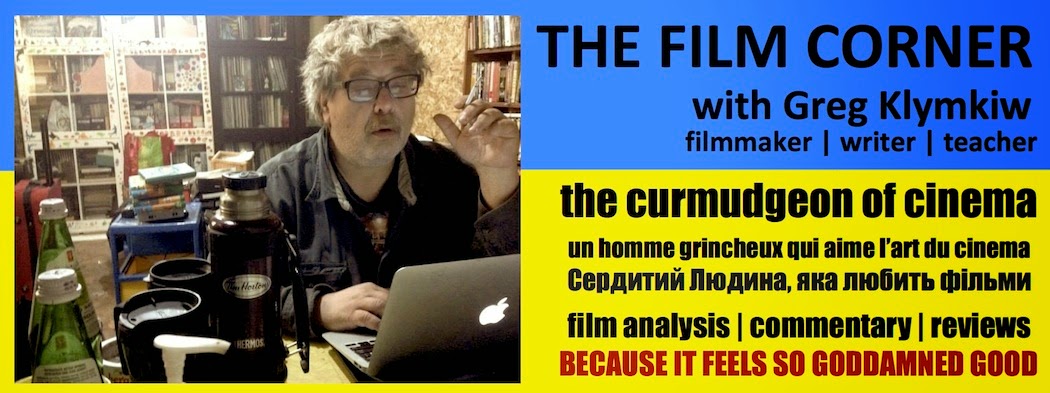
ABOUT GREG KLYMKIW - un homme grincheux qui aime l'art du cinema: Greg Klymkiw’s 35 years in the movie business includes journalism, screenwriting, script editing, producing and 13 years of service to Norman Jewison's Canadian Film Centre as the senior creative consultant and producer-in-residence. In addition to producing iconoclastic work by Guy Maddin, Cynthia Roberts, Bruno Lazaro Pacheco and Alan Zweig, his legendary guerilla campaigns as the Winnipeg Film Group’s director of distribution and marketing placed prairie post-modernist cinema on national and international stages. In addition to Klymkiw Film Corner, he writes for POV, Phantom of the Movies' VIDEOSCOPE and among others, Electric Sheep - a deviant view of cinema. He's writing a book about screenwriting entitled "Movies Are Action" (featuring interviews with the world's best filmmakers). He is the subject of a documentary by Ryan McKenna entitled: "Survival Lessons: The Greg Klymkiw Story". At last count he had seen over 30,000 feature films.
GUIDE TO STAR RATINGS: ***** Masterpiece **** Excellent ***1/2 Very Good *** Good **1/2 Not Bad ** Whatever
*1/2 Poor * Raw Sewage . . . If a film is not quite up to earning a 1/2 star or 1 star, it will earn at least 1 Pubic Hair.
Une Femme Douce (1969) dir. Robert Bresson
Starring: Dominique Sanda, Guy Frangin, Jeanne Lobre
*****
By Greg Klymkiw
From the top floor of an apartment building balcony, a white scarf floats gently in the breeze while its owner, a stunningly beautiful young woman (Dominique Sanda) lies crumpled on the pavement after an intentional fatal dive. We know her fate, but Robert Bresson, through the cold narration of her husband (Guy Frangin) takes us on the harrowing journey that led to her decision.
Une Femme Douce is not only the portrait of a loveless marriage, but given the perspective Bresson has chosen to impart the tale, it's as much a film about how cruel and blind a man can be when he places the gaining of material wealth before the happiness of both himself and the woman he purports to love.
Bresson never waivers from the husband's biased rendering of the marriage. Though we are shown everything through the greed-clouded memory of this one man, we see what he doesn't. Bresson, however, does not use his directorial hand to guide us. He shows us what is plainly before the man. We, are the ones who make up our own minds as we piece the puzzle together.
This unique approach to storytelling is what has made the film one of the greatest of all time, and yet another magnificent example of work that influenced filmmakers the world over.
Adapted from the Fyodor Dostoyevsky story "Krotkaiya" ("A Meek Woman"), Bresson updates the tale to contemporary France, but remains faithful to the literary source. The major change is that the man in the Dostoyevsky piece was a disgraced former member of the military who becomes a lowly pawnbroker. Bresson wisely and brilliantly places the character in a position that would speak more clearly to audiences of today by making him a disgraced former banker. This also plays brilliantly into the petty stinginess of the character.
At first, the man seems genuinely taken with the willowy young lady who enters his shop with one knick-knack after another and he continually gives her far more money than her items are worth. Their exchanges are marked by the woman's silence, but eventually, she drops her guard and the two begin to talk.
He eventually professes his love to her and begs for her hand in marriage. To his delight, she accepts. Their wedding night proves to be a success - at least according to the man and he welcomes his new bride into his shop and begins to teach her about both the business and the joys of capitalism.
Things seem pleasant enough, but slowly the woman begins to show compassion for those who desperately come to the pawn shop - parting with their sentimental baubles in exchange for a tiny bit of cash in order to live. She begins to pay people more than what the items are worth. In a sense, she is doing what he husband did for her. The difference in that her designs are genuinely altruistic. His were an insidious attempt to "buy" her love.
The husband, sees none of this, It's right before his eyes.
Through Bresson's camera, it's before our eyes also.
His wife's charitable nature angers him and he becomes even more obsessed with the idea that she must be drilled more intensely with the regimen of greed. She rejects this, as she also begins to reject his increasing cheapness in all matters. This infuriates him to the point of distraction and her eventual and continual disappearing acts when she gets angry, metamorphosise from pure anger into extreme jealousy as he assumes she has taken a lover.
When she falls gravely ill, however, he showers her with the finest medical attention money can buy, dotes upon her endlessly and professes his love anew - promising that he will devote himself to her wholeheartedly and furthermore, that he will arrange a lovely, extended vacation for the two of them.
This, should be enough to suggest that things will turn around.
This, however, is a film by Robert Bresson - adapted, no less, from Dostoyevsky.
Two key symbols reign over the film. One is the image of cages in a zoo - shot from inside the cage and looking upon both the man and woman as they peer at the animals. On one hand, it might be suggested that she is in a prison - or more accurately, a zoo cage. She's a live creature with its wings clipped by this petty bourgeois pawnbroker.
This is true enough, but the fact remains that Bresson's camera eye peers at both of them through the cage. In fact, the camera is below eye level as they look up at the monkeys in the cage. The camera itself is, on one hand detached and clinical, but because it is not a direct point of view shot from the animals' eye-line, it's especially clear that the husband and wife are the prisoners. Both of them are incarcerated, but it's the worst kind. They're trapped together in a cell that neither of them should be sharing.
The second, and perhaps most powerful symbol is a plastic moulding of Jesus on the cross which she takes to the pawnbroker early in the film. He's far more interested in the gold cross which the plastic Jesus is affixed to. He removes Christ, handles the gold greedily, places the lucre on a scale and offers her a whack of cash and the Jesus figurine. This cheap plastic Jesus takes on considerable resonance in both this scene and much later on. On the surface, it is a seemingly worthless bauble, but is, in fact representative - at least to the woman - of something much greater.
Once again, Bresson's mise-en-scene is imbued with a precision few directors can even come close to rendering and his pace, though measured, and his shots, though seemingly straightforward and his takes, far longer than what's normally expected, especially in contemporary cinema, all contribute to generating a film that is pure Bresson.
As such, it is a film of extraordinary power and even within Bresson's almost clinical approach, it is practically exploding with humanity of the most indelible kind.
The final image of her coffin being screwed shut cuts breathtakingly to black and we are left in the darkness to contemplate all that is human, all that is wretched, all that is humanity itself.
Bresson plunges us headlong into the terrible beauty of life and what it means to be human.
We are, without a doubt, all the better for it.
"Une Femme Douce" is screening as part of the TIFF Cinemtheque's major retrospective organized and curated by the legendary programmer James Quandt. Aptly titled "The Poetry of Precision: The Films of Robert Bresson", this and every other Bresson film is unspooling at the TIFF Bell Lightbox in Toronto and over a dozen cinemas across North America. The film is screening at TIFF Bell Lightbox Thursday March 8 at 6PM and Saturday March 10 at 4PM . Tickets are available HERE. "Une Femme Douce" is also available on DVD.
Le Diable Probablement (The Devil, Probably) (1977) dir. Robert Bresson
Starring: Antoine Monnier, Tina Irissari, Laetitia Carcano, Henri de Maublanc, Régis Hanrion
*****
By Greg Klymkiw
The key to unlocking the mysteries of this extraordinary film by Master Robert Bresson is, at least for me, found within a scene depicting a bus ride where the central character Charles (Monnier) declares that "governments are shortsighted". A nearby passenger responds that governments are not to blame for the sorry state of the world, but that "the masses" are the true guilty party.
I think there's truth in both. The masses, or to my way of thinking, the sheep - are like the blind leading the blind and because of the lack of foresight within majorities, they are easily influenced by governments, who in turn hold the POWER to lead, but for all the wrong reasons.
In the same scene, another passenger responds with a query that implies that someone or something forces the masses to "determine events" and that this mocks humanity. As such, he wonders who or what precisely leads the masses "by the nose".
The answer provided by the first passenger, which happens to also be the the title of the film is, quite simply: "The Devil, probably." For me, the Devil he/Bresson refers to IS government, or whatever true power is that GUIDES government. There is an evil in the World and it IS the Devil as, of course, a symbol of evil which is, in turn, one and the same with the God created by mankind (no matter which religion, ultimately - save perhaps for Buddhism) to instil fear, and in so doing, to yield the ignorance necessary to guide the masses any which way they need to be guided.
Even more telling for me is that Bresson has chosen to set his film against the backdrop of the student riots in France during the 70s whereupon, in the film's early stages, the almost Christ-like figure of Charles (the clearly non-Semitic, almost Nordic European version popularized in so much art during the first millennium) rejects the well-meaning, but ultimately empty rhetoric of the movement's leaders. Like Christ, Charles knows in his heart that he must sacrifice his life. The clear difference though, has less to do with making a sacrifice for mankind, but for himself.
Charles is disconnected from society and from the beginning of the movie we know he is dead. Bresson takes us back in time and we join Charles on his odyssey to seek some meaning and/or spiritual guidance during his last months - hoping he CAN change his mind about committing suicide.
Unlike Christ, though, he does not spend 40 days and 40 nights in the desert - alone with his Father. Charles seeks solace in the society he feels disconnected to. Abandoning the youth movement, he looks to the company of friends, nature, education, religion and even psycho-therapy. He receives no answers.
His choice becomes clear.
There is, however, a powerful implication that even Charles, for all his rejection of society, and most importantly, religion, still adheres to the idea that suicide is a sin and he seeks someone to murder him in order to not pull the trigger himself, thus risking eternal damnation.
Bresson creates yet another masterpiece. He hangs back and almost clinically depicts Charles's journey with the detachment of a scientist observing a specimen. There is, however, NOTHING cold about the thoughts and emotions this approach elicits. The movie is as deeply and profoundly moving an experience as great art should be - fuelling the mind and spirit whilst generating the visceral response of sadness, even despair.
The universality of this story is so overwhelming. Youth, no matter what generation they're from, has always experienced a disconnect from a society ruled by others. In this sense, the film feels as fresh today as it must have been in 1977.
One of the most powerful sequences has a group of the young people in a library A/V room watching a 16mm print of a documentary as they make notes for what might be a class assignment or even to simply provide some illumination upon their own disharmony with the world. The footage they watch looks like it could have been filmed just yesterday - depicting mankind's abuse of nature - everything from the culprits behind the depletion of the ozone layer to the horrific battering of a baby seal's head. We're as devastated with these images as are the young people watching them.
I defy any thinking person, no matter what their generation, to not be shaken, shattered and hopefully, illuminated by this great film that will, no doubt, live forever.
"Le Diable Probablement" is screening as part of the TIFF Cinemtheque's major retrospective organized and curated by the legendary programmer James Quandt. Aptly titled "The Poetry of Precision: The Films of Robert Bresson", this and every other Bresson film is unspooling at the TIFF Bell Lightbox in Toronto and over a dozen cinemas across North America. The film is screening at TIFF Bell Lightbox Sunday March 4 @ 5PM and Thursday March 15 @ 6:30 PM. Tickets are available HERE. "Le Diable Probablement" is also available on DVD.
The Trial of Joan of Arc (1962) dir. Robert Bresson
Starring: Florence Delay (Carrez), Jean-Claude Fourneau
*****
By Greg Klymkiw
"I had a daughter born in lawful wedlock who grew up amid the fields and pastures. I had her baptized and confirmed and brought her up in the fear of God. I taught her respect for the traditions of the Church as much as I was able to do given her age and simplicity of her condition. I succeeded so well that she spent much of her time in church and after having gone to confession she received the sacrament of the Eucharist every month. Because the people suffered so much, she had a great compassion for them in her heart and despite her youth she would fast and pray for them with great devotion and fervor. She never thought, spoke or did anything against the faith. Certain enemies had her arraigned in a religious trial. Despite her disclaimers and appeals, both tacit and expressed, and without any help given to her defense, she was put through a perfidious, violent, iniquitous and sinful trial. The judges condemned her falsely, damnably and criminally, and put her to death in a cruel manner by fire." - Statement by Isabelle Romee, Joan of Arc's mother, made prior to the commencement of the Catholic kangaroo court proceedings against her daughter.
Go ahead. Call it sacrilegious if you will, but for me, Robert Bresson's The Trial of Joan of Arc is, at one level, imbued with such intensity, that it delivers a kind of pulp ferocity reminiscent of the best episodes of Perry Mason, the long-running TV series from the Erle Stanley Gardner novels that starred Raymond Burr. Shoot me. Crucify me. Burn me at the stake. Bresson deserves reverence, serious analysis and just plain worship, BUT he also needs to be acknowledged for delivering film after film that harnesses every bit of the medium's power to generate material that is as compulsively entertaining and thrilling as the best movies are, and should be. And this film rocks big-time!
My first helping of the picture had me on the edge of my seat - in spite of, like all of Christendom, knowing the tale of the Maid of Orleans. Joan of Arc was the simple French peasant girl who, proclaiming the voice of God was guiding her, successfully led an army against British rule over her country and was subsequently turned over to England, tried for heresy and burned at the stake. Her story is that of an utterly horrible betrayal and miscarriage of justice at the hands of her fellow countrymen and the Catholic Church.
Using the actual trial transcripts and eye-witness testimonies of those who were present, Bresson's film has all the snap, crackle and pop of great courtroom drama. Watching the movie is, like many a fine procedural, gripping in that maddening fashion where we witness someone who is clearly innocent being hammered by a judicial system bent on proving its case at any cost. The difference, of course, is that the judiciary in this case are outfitted in the robes of the Catholic Church rather than that of "the Crown" and there is NO Perry Mason to save the accused. (I suppose I could say, that Joan's Perry Mason is God, and that for many, Perry Mason is, in fact God, but I'll refrain from doing so.)
The vast majority of the film's running time is the back-and-forth between Joan (Florence Delay) and her primary interrogator Bishop Cauchon (Jean-Claude Fourneau) - first in an open "court", then within Joan's cell (to keep the rabble to a minimum and control the proceedings further). Bresson employs his trademark approach of coaching his actors (or, if you will, non-actors - Delay was an academic and Fourneau a renowned painter) to deliver their lines as naturally as possible - in longer takes and almost never in closeup.
Even with his usual style, the original transcriptions come across as expertly rendered courtroom dialogue. In reality, neither Cauchon nor Joan (especially) were no fools. They both give as good as they get. For every volley fired by Cauchon, Joan retaliates with a vigour and intelligence that knocks the Bishop on his ass - and, for that matter vice-versa.
Cauchon needs to find Joan guilty of heresy. Joan needs to fight for her life. The stakes are high for both parties and one senses that on occasion there are even moments of a strange mutual admiration between the two opposing forces - so much so that one is almost rooting for that turn in the plot (as it were) when Cauchon comes to his senses and dispenses with this whole sham of a trial.
Where things become especially gripping and extremely emotional for a viewer is that Cauchon will NEVER have this turn - we know this because we know what ultimately happened, but also, we see how Cauchon is trying to twist everything Joan says and, in fact, is even trying to control what's being entered into the official record. At one point, both the audience and Joan are agog when the findings are read out loud and clearly, obviously ignore EVERYTHING that's preceded them.
As the trial moves forward, there's a horrific ever-mounting inevitability to the proceedings. Bresson, for all his (and his academic critics) crowing about how he eschews traditional filmmaking techniques, the movie, under the steady guidance of Bresson's direction, often betrays this notion and careens brilliantly as if it were a courtroom procedural par excellence.
Between the courtroom scenes, Bresson delivers moments of solace with Joan in her cel. These provide a certain respite from the proceedings and allow Joan and the audience an opportunity to contemplate what's been going on and, more importantly, what might be next. The pace this creates is so dynamic that again, it almost flouts the traditional Bressonian approach. I'd argue, however, it not so much sways from his style, but uses his style to deliver the sort of gripping cinematic narrative he so often tries to distance himself from.
The bottom line is that this is yet another Bresson film which, for me, displays both his art AND exceptional craft. As a filmmaker, he runs rings round almost every other filmmaker who ever existed (or will EVER exist).
I've probably spent enough time linking Bresson's work here to, uh, Perry Mason, so allow me to briefly make the inevitable comparison between The Trial of Joan of Arc with Carl Dreyer's immortal The Passion of Joan of Arc. Dreyer brings austerity to his approach also, but it's in the art direction most of all. The rooms are strangely unadorned and chalk white, whereas Bresson's rooms feel much "fuller" - perhaps mostly due to his rich, yet more straightforward compositions.
Dreyer employed the more baroque approach to composition - strange angles, intense closeups, crazed cutting (over 1500 cuts and many of them brilliantly breaking every rule of montage) and virtually no sense of spatial reference. Dreyer seeks to disorient us - so much so, that he flings us at Joan in a manner that we become Joan and feel every horrendous accusation volleyed at her.
Bresson, on the other hand, is far more measured. His compositions and lighting are gorgeous, but they are also there to place emphasis upon the proceedings and to understand Joan's place in this perverse kangaroo court and how she deals with it. Dreyer's Joan is assaulted, as are we, the audience, from beginning to end. Bresson's Joan fights back - again and again, while we seemingly fight back with her.
Amidst his manically edited mise-en-scene, replete with off-kilter perspectives, Dreyer's lighting emphasizes shades of white and grey, whereas Bresson plays with light in very different ways and is not afraid to fill his frame with darkness. All this said, however, it would be remiss of me to not mention that Bresson too employs a few extraordinary shots that are not straight-forward at all. One of the more powerful visual juxtapositions occurs at both the beginning and end of the film where Bresson employs a moving camera in both to follow two very different strides Joan takes - one towards her trial, the other towards her execution. Both are examples of Bresson's visual virtuosity and how he uses his camera eye to elicit emotional responses - again BOTH in Joan and we, the audience.
Dreyer, like Bresson, adhered to the transcripts of the actual trial, but his film is silent and he is forced by that very necessity to create a completely different approach. (The respective actresses playing Joan also couldn't be any different in look and playing style - yet both provide more than convincing and passionate renderings of the same character.) Dreyer creates a soundscape, a music, if you will, with his cutting style. Watching the film WITHOUT musical accompaniment is proof positive of this. Bresson, on the other hand, uses sound to convey more than dialogue. He builds an aural world with choice sound effects and employing silence as either the natural metre of said dialogue or to provide the aforementioned moments of solace. And in two instances, Bresson employs ear-shattering whacks on a drum skin that are so sharp, so jarring and jangling, you feel like you're being battered - assaulted.
Both works are highly experiential and use the same source material, but both seek to tackle this tragic tale by providing respective experiences that on their own are very powerful, but when viewed side-by-side are perhaps the greatest artistic rendering of this very real and horrifying subjugation of a strong and intelligent woman at the odious patriarchal hands of the Catholic Church.
The Trial of Joan of Arc exists, finally, in its own unique realm. The movie is a slice of life that uses all that cinema can offer to create a film that will infuriate, excite and finally move you to tears.
It's utterly devastating.
"The Trial of Joan of Arc" is screening as part of the TIFF Cinemtheque's major retrospective organized and curated by the legendary programmer James Quandt. Aptly titled "The Poetry of Precision: The Films of Robert Bresson", this and every other Bresson film is unspooling at the TIFF Bell Lightbox in Toronto and over a dozen cinemas across North America. The film is screening at TIFF Bell Lightbox Friday March 2 at 6PM. Tickets are available HERE. "The Trial of Joan of Arc" is also available on DVD.
There is so much evil in this world that the last place one expects to find it is in Switzerland. This is, after all, a country that has had a long-honoured tradition of peace-building and has remained staunchly neutral in times of war - so much so that the country has not officially been at war since 1815. The country is not only home to innumerable health, human rights and philanthropic organizations, but is the birthplace of the Red Cross.
Based, however, on its record of witch-hunting political refugees living within its borders, rounding them up systematically, incarcerating them in a prison-like detention centre and worst of all, playing horrendous mind games upon these people to get them to willingly leave, I can only conclude that Switzerland is as capable of evil as horrific as the countries that threatened to persecute and/or annihilate these people in the first place and that will do so if and when they are shipped back.
Even worse, is that Switzerland's aggressive actions against political refugees is steeped clearly in racism. The vast majority of these hapless souls are people of colour.
All this said, given Switzerland's less-than-stellar record of harbouring the financial fortunes of corporate criminals and Nazis, perhaps this isn't all surprising.
And frankly, where there is such an over-zealous sense of "neutrality", one will find bureaucracy of the most inhuman and pernicious kind.
For me, Special Flight, is mainly about bureaucracy and how it conducts the dirty work of politicians and other white-collar criminals in a "clean" manner. As always, bureaucracy is all about nest-feathering, doing one's cog-like "duty", providing endless buffer zones to deflect responsibility and keeping one's hands clean. Aside from the clean hands bit, the workings of bureaucracy are like any evil totalitarian regime.
And watching the plight of this group of political refugees is like watching sick, slow, mind-numbing psychological torture - perpetrated by Totalitarians who pretend NOT to be Nazis.
The movie follows the lives of several individuals in Switzerland's Frambois Detention Centre. On the surface, this is a place that adheres to many of the values one normally equates with Switzerland or, for that matter, any reasonable democratic state.
The detainees are treated with relative dignity, they're well-fed, provided clean accommodations, wages for any work they do within the walls of the centre, visitation privileges with family and friends, recreational facilities, sporting and cultural programs and, friendly, humane treatment from the wards of the centre.
But, they are prisoners.
Appallingly, many of these refugees have been peacefully living in Switzerland for years - working, paying taxes, paying national health fees, holding legal drivers' licences and even identity papers. Many of them have married Swiss citizens and had children. They are, for all intents and purposes, fine, productive, law-abiding citizens of the country and only a small minority of them have engaged in aberrant/illicit activities.
They have been rounded up, often "innocently" during minor moving violations and the like, immediately thrown into the detention centre and forced to wait there until they get a hearing before an immigration judge to assess their refugee claims. This takes months to years. They are torn from their homes and families and kept as prisoners of the state.
And I reiterate, they are primarily people of colour.
This is so clearly a racist action.
And it is evil.
Their human rights ARE being violated. They aren't being physically tortured, but the psychological torture is extreme and, I'd argue inhuman.
The film follows one group of detainees. We see their lives in the centre, the burgeoning friendships, their relationships with their wards (guards), visits with family and lawyers, recounting of their individual tales that forced them to leave their countries and move to Switzerland in the first place and their actual trials in immigration court.
Prior to their court hearing, they are counselled to peacefully accept the decision of the court if it doesn't go in their favour. In fact, they are counselled in this manner on numerous occasions before and after court. If they are deported, they do have the right to refuse boarding the plane - however, they must be handcuffed, driven to the airport and taken to the gates. There and only there can they refuse. And even there, they are given more counsel as to why they should cooperate.
And what, pray tell, is the reason they are given to cooperate? Well, if they don't, they will be taken back to the detention centre to wait even longer - not for an appeal, but without warning, to be hauled out of the centre and put on a "special flight".
The "special flight" is not in any way, shape or form special - it's degrading and inhuman - and will, in fact, single these political refugees out to officials in the countries that persecuted them in the first place.
I have not even begun to scratch the surface of this abomination. The film will leave you shattered and demoralized that any of this is going on at all in the "free" world.
What we see, finally, is example upon example of the most ludicrous bureaucracy foisted upon these people and what is especially maddening are how the bureaucrats do their jobs. They are cogs. They have one job and one job only. They will only deal with the job at hand. They will listen to nothing else from their charges unless it specifically relates to the job at hand - which is almost always devoted to booting these people out of a country they've lived in for years.
Special Flight is jaw-droppingly shocking and all the more harrowing as it depicts a form of "polite" persecution and thinly veiled racism.
The nightmare these political refugees find themselves in is to be placed in the care of a system that inspires its bureaucrats to repeat words over and over again that are not too dissimilar to words we've heard from war criminals.
"I have a job to do" is their mantra and it always - ALWAYS! - sounds like those chilling words, "I was only following orders."
"Special Flight" is part of the TIFF (Toronto International Film Festival) "Human Rights Watch 2012" which feature nine films that tell stories of oppression and corruption from around the globe. It is playing for one show only on Wednesday February 29 at 8:00 PM. For a full list of films, descriptions and to buy tickets, visit the TIFF website HERE.
Act of Valor (2011) dir. Mike McCoy, Scott Waugh
Starring: (I kid you not - real Navy SEALs who do not use their last names in the credits because they're all in active duty) Lt. Rorke, Dave, Sonny, Weimy, Ray, Ajay, Mikey, Van O (and several "real" actors) Alex Veadov, Jason Cottle, Rosalyn Sanchez, Ailsa Marshall, Nestor Serrano, Emilio Rivera
**
By Greg Klymkiw
Upon hearing I'd just seen Act of Valor, a dear friend of the decidedly light-loafered persuasion was eager to know how much soft-core gay pornography was on display in the movie - after all, it's a war picture starring a whole whack (as it were) of buff real-life Navy SEAL pretty boys and God knows, there might well have been plenty of male bonding hijinx in the tents, showers and locker rooms as the lads, adorned only in their clean, white undies snapped wet towels at each other or gave each other healthy slaps on their firm buttocks or, better yet, sported their no-doubt formidable schwances full of soap suds.
I had to sadly report that the only real pornography on display was pro-American-military porn. And make no mistake, this movie comes very close to the usual definition of the word in so far as the movie features plenty of repeated sensationalistic depictions of actions meant to arouse physical and emotional sensations in its audience with little artistic value beyond said depictions. I would, however, emphasize "little" artistic value to mean that the movie does actually have SOME artistic value - as propaganda.
With the full blessing of the American military and all the armaments any war movie could possibly want, Act of Valor purports to be a realistic depiction of Navy SEALs in action, in the field of battle. The movie is bracketed by a grotesquely sentimental narration which turns out to be a letter to the child of a SEAL who never made it home to see his son born. It almost hilariously describes every member of the military team as being some loser miscreant prior to their induction into the life of soldiering - how they finally found meaning in their lives as protectors of America. There's no irony at all in this narration. There should be, since the military - especially in America - targets those who haven't got too much else on the ball save for their ability to be turned into killing machines and, in turn, fodder for the bullets of America's perceived enemies.
In the case of this film - the enemies are clear. They are Muslims first and foremost - rabid Jihads bent on serving Allah in his war upon the Infidel. Second only to Muslims are Russian-Jewish gangsters who smuggle arms and Jihads for profit. Thirdly, members of drug cartels who protect Jihads are also on the list of America's enemies.
And these are whom our glorious boys do battle with.
The plot, such as it is, involves a female CIA operative who is kidnapped and tortured (in the most graphic detail - at one point with a power drill). The SEALs raid the compound she's secured in, assassinate a small army of scumbags and proudly return her home. Alas, the movie makes a point of saying how this woman failed in her mission. She's tortured on-screen in the most horrific fashion, but unlike the men who sacrifice THEIR lives, her character is singled out for screwing up.
Oh well, war is for men. Not women. I guess. Or something. Huh? Whatever.
Then we're introduced to a Russian-Jewish gangster who masterminds the smuggling of some Chechen Muslim Jihads into - God Help Us - AMERICA!!! Their plan is to make 9/11 look like a minor fender bender.
Will America's finest make use of their buff bods' and superior firepower to put these scum in their place?
You betcha!
Like most propaganda, this is unbelievably stupid and aimed at the most brain-bereft audiences. That said, the first forty minutes of the film is, from a purely technical standpoint, brilliantly directed, shot and edited action. Even though we care less about the soldiers themselves, the movie does manage to invest us in the character of the female CIA operative and the rescue mission contains gut-wrenchingly suspenseful action.
Eventually though, we're left with the rest of the mission - to stop the Russian Jew and the Chechen Jihads and, by extension the Latino drug dealers. Here, the movie loses all emotional punch, though it does feature more superbly executed action.
What's so phenomenal about this movie is that it unblinkingly shows this military force of trained killers jetting all over the world, entering whatever country they bloody well want to and decimating hundreds, if not thousands (in reality) "bad guys" all in the name of "freedom" and to protect America from terror.
Not once does the movie ever even briefly suggest that the terrorism is rooted in America's imperialistic goal to control oil and other resources in the name of "freedom". It just blindly accepts that the world is full of bad Muslims, evil money-grubbing Russian-Jews and Latin drug cartels and that the only thing worth preserving are American ideals.
This is the most jaw-dropping military recruitment movie pretending to be entertainment that I've seen in recent memory. Not one "villain" is American and the only non-American hero is a Mexican military operative.
The movie is sexist, misogynistic, racist, ethnocentric, militaristic, jingoistic and mind-numbingly brain-dead. That said, the directing team (one a documentary filmmaker, the other a former stunt coordinator) are not brain-dead at all - they're terrific craftsmen who know how to make action pump along in ways that do not resort to the sloppy, cutty, geographically-challenged manner of most contemporary action movies.
I'd love to see these guys with a real script and real actors someday.
In the meantime, if you're into military porn, Act of Valor was made just for you. This detestable, borderline evil American military propaganda is so politically vile that it makes Leni Riefenstahl's Ode to Hitler Triumph of the Will seem like a Walt Disney "True-Life" Nature documentary from the 50s.
By the movie's end, I had no other thoughts save for two:
When will Americans learn that "Valor" is actually spelled "V-a-l-o-u-r"?
AND...
When will Americans admit that they're fighting for rich people who are happy to use them as fodder to increase their wealth?
Well, I can't speak to the country's woeful disregard for the Queen's English, but to the latter question, I suspect that if they ever realized they're being duped, then we wouldn't have movies like Act of Valor.
I believe this is what's referred to as a "tender mercy".
"Act of Valor" is in wide release and is distributed in Canada via Alliance Films.
Au hasard Balthazar (1966) dir. Robert Bresson
Starring: Anne Wiazemsky, Walter Green, François Lafarge, Philippe Asselin, Nathalie Joyaut, Jean-Claude Guilbert
*****
By Greg Klymkiw
“Those who fail to exhibit positive attitudes, no matter the external reality, are seen as maladjusted and in need of assistance. Their attitudes need correction. Once we adopt an upbeat vision of reality, positive things will happen. This belief encourages us to flee from reality when reality does not elicit positive feelings . . . [The Law of Attraction] argues that we attract those things in life, whether it is money, relationships or employment, which we focus on. Suddenly, abused and battered wives or children, the unemployed, the depressed and mentally ill, the illiterate, the lonely, those grieving for lost loved ones, those crushed by poverty, the terminally ill, those fighting with addictions, those suffering from trauma, those trapped in menial and poorly paid jobs, those whose homes are in foreclosure or who are filing for bankruptcy because they cannot pay their medical bills, are to blame for their negativity."" - Chris Hedges
Not much has changed since Robert Bresson gave us his extraordinary Au hasard Balthazar. Poverty, ignorance and hatred run rampant, yet hidden within the miasma of humanity is grace. Some of us find it, others sadly discover it in death. Bresson's entire canon of cinema unflinchingly presents an "external reality" so full of depth and I think that perhaps this is no more powerful and apparent than in this heartbreaking tale of a donkey - from birth to death. Bresson begins with the purest state of grace - that of seeming innocence and ends, finally, in the ultimate state of grace where a life lived meets its demise and we hope, finds peace.
This is a movie that always moved me deeply. With each viewing it plumbed spiritual and emotional depths that few movies could offer so consistently. As I grew ever-older and realized how so much had not really changed in the world, it became a film that was alternately ever-difficult to watch and yet, impossible to turn away from. Perhaps this is because I increasingly seemed to take the perspective of the beleaguered Balthazar - watching the lives onscreen that paralleled his own, yet thinking of the lives (including my own) beyond the frame of Bresson's cinematic borders.
This is great art - it grows with you and remains universal.
The tale is simple. Balthazar as a foal receives the love, gentle caresses and blessings of Maria and Jacques (Anne Wiazemsky, Walter Green) who also pledge their eternal love for each other before both the Heavens and the dark coloured, white-tufted gentle donkey. As time passes, however, Balthazar is passed from owner to owner - experiencing brutal beatings and back-breaking work. Jacques continues to carry a torch for Marie, but she finds herself attracted to the cool, leather-jacketed brute Gérard (François Lafarge) who uses her and abuses her. Marie's Father (Philippe Asselin) drives his family and fortunes to ruin with his stubborn pride while her Mother (Nathalie Joyaut) helplessly and disapprovingly casts her eye to the actions of husband and daughter.
Through all of this, Balthazar suffers pain, exhaustion and indignity - his only respite being led to an occasional bucket of food or water and his stable at night. He is briefly passed into the hands of the town drunk (Jean-Claude Guilbert) who treats him with kindness, not unlike Marie at the beginning of his life and the old woman who regards him as a "saint" towards his demise. For poor Balthazar, the only time he receives any sort of adulation is in one of the most extraordinary sequences ever committed to film when he is leased out to a circus and performs a spectacular mathematics trick under the big top.
Bresson never resorts to giving Balthazar "human" reactions to anything he witnesses. As the lives of the people in his life proceed, Bresson will occasionally cut to a close or medium shot of the donkey's poker face and/or seemingly blank eyes. In those eyes, soulful, deep, watery - we supply our own thoughts and perceptions as if Balthazar is the mirror into which we gaze for our soul. It's not unlike those times when one kneels in a church, gazing up at a twisted crucifix bearing Christ - we search for answers in an image of suffering.
The usual reactions we get from Balthazar to anything in the film are when his whole body flinches in pain at the crack of a whip, a blow from a fist, or in one of the cruelest moments, when the nasty Gérard affixes a piece of paper to the donkey's tail and sets it on fire. Even more poignant is a scene when the soulful Balthazar flinches in terror at the horrendous explosions that occur when bunch of drunken young men let off several firecrackers near him.
When Balthazar, near death, rests in a gentle meadow filled with sheep, who at first surround him, then leave him alone to die - quietly and at peace - we weep.
We weep for all of God's creatures and the hope that grace will somehow finally touch us all.
With Au hasard Balthazar, Bresson gives us a film that is as much about this abused donkey as it is about the cruel, prideful, ignorant and uncaring people who wend in and out of his horrendous life. He gives us a world where we must ultimately feel both empathy and sympathy for all of these creatures - a world where we must gaze deep into the eyes of a donkey and experience humanity in all its bitter realities.
It is, finally, as much about us as anything else and there are ultimately few films that achieve this with the grace and power that are rendered here by Monsieur Bresson
"Au hasard Balthazar" is part of the TIFF Cinemtheque's major retrospective organized and curated by the legendary programmer James Quandt. Aptly titled "The Poetry of Precision: The Films of Robert Bresson", this and every other Bresson film is unspooling at the TIFF Bell Lightbox in Toronto and over a dozen cinemas across North America. The film is screening at TIFF Bell Lightbox Sunday February 26 at 5:00 PM and Thursday March 1 at 6:00 PM. "Au hasard Balthazar" is also available on a stunning Criterion Collection DVD. The extra features on this disc are especially tremendous - most notably, a one-hour French television documentary from the film's time of release that focuses upon the film in such depth that it makes one long for this kind of analysis and exploration in contemporary works in the same way (instead of the pathetic puff-pieces that feel more like electronic press kits). "Au hasard Balthazar" is definitely worth owning, but only AFTER or in TANDEM with seeing the picture ON A BIG SCREEN - ON FILM.
GOON (2011) dir. Michael Dowse
Starring: Seann William Scott, Jay Baruchel, Liev Schreiber, Alison Pill, Eugene Levy, Kim Coates, David Paetkau. Marc-André Grondin
****
By Greg Klymkiw
I kept wondering when a great Canadian hockey movie would come along. The truly cool Golden Age of Canadian Cinema in the 70s and early 80s yielded George McCowan's legendary Face Off (with its phenomenal rare 35mm footage of actual NHL action from the period), Peter Pearson's Paperback Hero (with the irrepressible 70s anti-hero played by Keir Dullea) and Zale Dalen's lovely ode to famed Saskatchewan kids' hockey coach Father Athol Murray, The Hounds of Notre Dame.
Canadian TV-movies in the 90s briefly flirted with hockey thanks to Atom Egoyan's still-pungent Gross Misconduct (about Brian "Spinner" Spencer) and Jerry Ciccoritti's superb Net Worth, which dealt with the struggle for a players' union and was, according to my Dad, not only a fine rendering of the period, but featured - in his opinion - a brilliant performance by Al Waxman as Detroit manager Jack Adams. Dad told me that Waxman captured Adams to perfection. Dad would know. He played briefly for the Red Wings WITHOUT a union in the late 50s and in spite of being cited by goalie Ken Dryden as a personal hero in his book "The Game" was subsequently booted by Adams after he broke his ankle.
So what happened? Where did all the Canadian hockey movies go? It's the country's God-Given national sport, for Christ's sake!
Well, not much of anything happened. Charles Biname's lame 2005 biopic of Maurice Richard, The Rocket, sadly didn't cut the mustard and as terrific as they were, the 90s TV flicks were revisionist takes on the sport Canadians embrace as steadfastly as maple syrup and beaver(s). And the less said about the loathsome Breakway and utterly inept Score: The Hockey Musical the better.
So basically, no great Canadian hockey pictures existed for 30 years - unless, of course, you count George Roy Hill's immortal Slap Shot with Nancy Dowd's delightfully foul mouthed screenplay, Paul Newman's sparkling player-coach Reggie Dunlop and, of course, the Hanson Brothers. Unfortunately, Slap Shot wasn't Canadian, though it should have been, and at times, sure felt like it.
When the movie came out, I was immersed in the world of hockey whilst hanging out with my Dad during the various promotional tie-ins he orchestrated via Carling-O'Keefe Breweries with both the WHA and Alan Eagleson's various "lost" Canada Cup series. The WHA was, of course, the world leader in bench-clearing brawls and I consider the most momentous occasion of my life to have been actually sitting in the Quebec Nordiques bench during their first bench-clearing brawl with the Winnipeg Jets.
Slap Shot nailed it by so indelibly capturing the on and off-ice atmosphere of hockey that I wasn't the only person in Canada who saw the movie dozens of times - ON A BIG SCREEN. In fact, Slap Shot was a huge hit in Canada, but flopped everywhere else in the world.
Oh, but thank Jesus H. Christ! Ah, fuck it! Thank ace Canadian director Michael Dowse!
The wait is over!
The Second Coming is here!
We are all now blessed with a Great Canadian Hockey Movie and the wait was well worth it!
Call it, The Rapture, if you will.
Based upon Doug Smith's novel "Goon: The True Story of an Unlikely Journey into Minor League Hockey" and with a screenplay co-written by everyone's favourite Canuck comic genius Jay Baruchel, Michael (FUBAR I & II, It's All Gone Pete Tong) Dowse renders yet another bonafide contender for masterpiece status.
Etching the tender tale of the kindly, but brick-shit-house-for-brains bouncer Doug Glatt (Seann William Scott) who is recruited to a cellar-dweller hockey team in Halifax to protect the once-promising forward Xavier Laflamme (Marc-Andre Grondin), Dowse captures the sweaty, blood-spurting, bone-crunching and tooth-spitting circus of minor league hockey with utter perfection. The camaraderie, the endless bus trips, the squalid motels, the brain-dead fans, the piss-and-vinegar coaches, the craggy play-by-play sportscasters, the bars reeking of beer and vomit and, of course, Pogo Sticks - it's all here and then some.
GOON delivers laughs, fisticuffs, mayhem and yes, even a dash of romance in a tidy package of good, old-fashioned underdog styling. Comparisons to Slap Shot, however, are going to be inevitable. GOON does lack the almost Bunuel-like set pieces of George Roy Hill's untouchable classic. Can anyone ever forget the interview with the Quebecois goalie wherein he describes what it's like to be in the penalty box? "You sit there. You feel shame." Or Paul Newman taunting an opposing team member about his wife going "dyke" with the mantra,"She's a lesbian, a lesbian, a lesbian." Or, finally, can any hockey movie - even a Great CANADIAN hockey movie like GOON ever top the Hanson Brothers and virtually anything they did - from "putting on the foil" to manhandling the Coke machine to smacking the helmets of the opposing team in their bench or the immortal slap shot that sends a puck sailing into the side of the organist's head?
Well, Dowse and his team are smart. They know you don't fuck with the Citizen Kane of hockey movies and instead try to move in a more, shall we say, esoteric direction. Whereas Slap Shot had the legend of Ogie Ogilthorpe, the worst goon in hockey history, GOON manages to go a step further and utilize a fabulous Ogilthorpe-styled character who is all flesh and blood.
Ross Rhena (Liev Schreiber) is the goon to end all goons. (Uh, yeah - Liev FUCKING Schreiber! This is one great actor and he delivers one of his best performances here.) Rhena is, in effect, a goon's goon. And what Dowse and team do here is perfect. They create a character with a bit of sentimental, old guard flavour and in one tremendously moving scene, Doug and Ross meet face to face in some squalid diner and engage in a conversation worthy of every great sports picture that ever featured the grand old man and the eager young up-and-comer.
Right across the board the casting and performances are first rate, but the revelation here is Seann William Scott as Glatt. His sweet, goofy, still-boyish appeal is so infectious, you actually enjoy seeing this happy-go-lucky lug doing what God intended him to do - bust heads.
I also suspect Mr. Scott can finally put his American Pie laurels as the immortal Stifler aside.
Glatt now reigns supreme in Le canon de Scott.
While GOON might not have individual set pieces on a par with Slap Shot, it more than makes up for this with quantity. You will never - in your life - see so much man-on-man carnage on the ice as you will in GOON, and it's not just a matter of quantity - the quality of the carnage is pure, exquisite bravura pulverizing.
It is a beautiful thing!
If Slap Shot is the Citizen Kane of hockey movies, GOON is The Magnificent Ambersons of hockey movies only now, imagine a work that rekindles the butchered glory of Orson Welles's masterpiece, but now on the blood-spattered hockey rinks of Canada!
It is a beautiful thing!
And fuck it, let's stretch the Orson Welles metaphor further. A great director needs a great editor. Welles had Robert Wise (an editor with the soul of a director). Dowse is blessed with Reginald Harkema (an editor with the soul of a director, 'natch!). If there are better editors in Canada than Reginald Harkema, I frankly have no idea who they are. The cutting in this film is utter perfection. Harkema slices and dices both comedy and action with equal aplomb.
Now granted, a director had to get the proper coverage for an editor to work such magic, but I was utterly floored by the cutting of the sequences on the ice. The sense of pace and geography is impeccable. Though Dowse has chosen a cuttier mise-en-scene than George Roy Hill, this doesn't result in the horrible mish-mash of cutty confusion in virtually every other contemporary action sequence. Harkema makes every cut a DRAMATIC beat and this is finally what gives GOON both its drive and emotional resonance.
It is, indeed, a beautiful thing!
If I have one quibble with GOON, it's that the filmmakers, due no doubt to exigencies of financing, chose to shoot in my old winter city of Winnipeg to stand-in for Halifax.
Come on, guys. Is Halifax really that pathetic?
"GOON" is in wide theatrical release via Alliance Films.
We Need to Talk About Kevin (2011) dir. Lynne Ramsay
Starring: Tilda Swinton, John C. Reilly, Ezra Miller, Jasper Newell, Rock Duer, Ashley Gerasimovich
*1/2
By Greg Klymkiw
Some might suggest that bopping around in time and space with dollops of dream imagery is art. It can be, but there is such a thing as bad art. Lynne Ramsay's new film - obtuse, mired in precious imagery, confusing narrative details and oh-so earnest (albeit fine) performances - is exactly the sort of film that appeals to psueds. They desperately desire to be taken seriously (mostly, I suspect, by other pseuds) and need healthy doses of un-sugar-coated horror mired in arty-farty tropes. This allows them to think they're sophisticated, even though they are, in reality, gulping down several gallons of bilge water to justify this pathetic form of self-congratulation.
We Need To Talk About Kevin (based on Lionel Shriver's acclaimed novel) drags us through the mire of one family's tragedy through fragments of the main character's mind - battered and deteriorated either by a mental breakdown instigated by a horrendous event or straight-up mental illness that was there from the beginning.
Strictly on the basis of the first time we see Eva (Tilda Swinton), I choose mental illness.
There she is, lolling about in some sort of Parisian outdoor orgy involving hundreds of sardine-packed losers swimming in pools of crushed tomatoes. This is clearly mental illness. Or stupidity. Or both.
Ah, but perhaps I'm being uncharitable. When we're young, surely we all enjoy exploring Europe on $5.00 a day, living in smelly hostels, backpacking through various non-touristy nooks and crannies and swimming in tomato sauce with hundreds of sweaty, unwashed Frenchmen.
We do, however, all grow up and Eva is no different. After swimming in tomato sauce, she puts her youthful penchant for such activities behind her and ends up marrying kindly, but somewhat dopey Franklin (John C. Reilly). They settle into a humungous palatial home in a weird small town in what I believe is some state in the southern U.S. of A.
Franklin appears to have no job, yet they live in an expensive home - one that seems bereft of more than a few sticks of furniture. Perhaps this is because Franklin does not have a job (which again begs the question how they can afford to live there - furniture or not).
Or maybe, just maybe, it's ever-so symbolic of how some people never really move into a home - that the notion of "home" eludes them.
"Good Grief," as Charlie Brown might say.
We get snippets of early romance twixt this mis-matched pair (which THANKFULLY includes darkly lit sexual hijinx) until the bulk of the movie takes us through three periods in their life with first-born Kevin (Rock Duer as toddler, Jasper Newell at age 8, Ezra Miller as teen). Buried amidst Ramsay's precious back-and-forth, this-way-and-that, all-over-the-bloody-place timelines, we discover Eva was indifferent about pregnancy in the first place and that Kevin, from birth it seems, is a nasty, uncaring little bugger with clearly psychopathic tendencies. Eva pretty much can't stand her child and in turn, the kid does everything in his power to make Eva's life miserable. On the other hand, Franklin and Kevin are seemingly perfect father-son soul mates - which, of course, befuddles and angers Eva.
At various points in the messy timelines, we get hints that something horrible has gone down. Seeing as Kevin is a psychopath and that Franklin, who can't see this, encourages his son in the art of archery, it's certainly no surprise early on that Kevin does something - shall we say - not very nice.
Luckily, Eva and Franklin eventually have another child - a sweet little girl, Celia (Ashley Gerasimovich). Given how loveable she is and what a horrid psychopath Kevin is (and, allow me to reiterate his penchant for archery), the occasional flash-forwards to Celia wearing an eyepatch suggests. . . well, I'm sure you get the picture.
I certainly did.
But wait! That's not all. Eyeless Celia is just the tip of the iceberg of horror. We know this because director Lynne Ramsay serves up snippets of Mom being harassed by media outside of a courtroom (sans Celia and Franklin), messy flashbacks and flash forwards to Eva living ALONE in some squalid house that's been splashed with red paint by local vandals and Eva desperately taking a job as a steno girl at a local travel agency.
We're further tipped off to some manner of malevolent shenanigans when Eva is accosted by Bible-Belt types in the street with slaps to her face and most ludicrous of all, a scene where Kevin orders a huge box of bicycle locks off e-Bay and does not offer, nor is even properly probed, for a reason why he's done this.
At this point, I kid you not, I thought: "Hmmm, those locks would be ideal to secure a big room full of people in order to take them all out, one-by-one."
"Good guess," I thought at a later point in the proceedings. Like the aforementioned pseuds, I gave myself a healthy pat on the back.
It's clear, almost from the beginning of this movie, due to the fractured narrative style, that Kevin will be indulging himself in a bit of the old ultra-violence - though perhaps not as entertainingly as that wrought by Alex in A Clockwork Orange.
It is also at this point that Ramsay is not so much presenting fragments of Eva's insanity, but is rather recreating (not all that successfully) the sort of thing most people do when tragedy strikes - they go over and over it, again and again, in order to make sense of it all.
We Need To Talk About Kevin is precisely the kind of movie an artiste makes when it's desired to make some social commentary on things the creator really knows nothing about. The sense of place is completely without realism (the artiste and her supporters might argue this is intentional) and there are holes in the narrative that one can drive a Mack Truck through (also, no doubt - ahem - intentional).
At a certain point in the proceedings, all I could think about was the GENUINE artistry that Quebec director Denis Villeneuve displayed in Polytechnique, his haunting, harrowing cinematic rendering of Marc Lepine's mass murder spree in Montreal. Villeneuve captured a time and place with such utter perfection - delivering a movie that did not live and die by pretentious trick-pony techniques as Ramsay's abominable film does.
We Need To Talk About Kevin is not without some saving graces. The performances of all three actors who play Kevin at various junctures in his life are phenomenal - we DO believe this is the same person throughout. John C. Reilly is, well, he's John C. Reilly - he's always tremendous to watch. Tilda Swinton suffers with her prim professionalism, but frankly seems so out of place in the milieu that it was ultimately impossible to buy her performance. This might not all be Swinton's fault since Ramsay completely botches the milieu. I still have no idea where and when this movie really takes place. Given the sloppiness of the storytelling, I'll concede I might have missed this point. Then again, as it's all through Eva's skewed perspective, it might be all, uh. . . I guess it's perhaps, uh. . . intentional.
Good grief, indeed!
Filmmakers who purport to care about their characters, but can only enter the lives of their characters by affixing some arty-farty technique that's rooted in the filmmakers's unflagging faith in their own apparent "brilliance" pretty much sickens me - especially when these stories deal with acts of violence perpetrated against children.
In Lynne Ramsay's case, this plodding, ugly mess of a movie makes me wonder if she knows ANYTHING about the human condition worth rendering on film and worst all, makes me second-guess the seemingly fine work she did directing her debut 1999 feature Ratcatcher.
"We Need To Talk About Kevin" is currently in theatrical release via E-One Films.
Les Dames du Bois de Boulogne (1945) dir. Robert Bresson
Starring: Maria Casarès, Paul Bernard, Elina Labourdette, Lucienne Bogaert
*****
By Greg Klymkiw
Hell hath no fury like a woman scorned and Robert Bresson easily delivers one of the sexiest, nastiest femmes fatales ever committed to film in his truly astounding Les Dames du Bois de Boulogne. Maria Casarès, who played the memorable Nathalie in Marcel Carne's Children of Paradise and was a favourite of Cocteau, takes on the role here of Hélène, a stunningly gorgeous woman of considerable affluence whose boredom and trifling leads to playing a dangerous game of deception and revenge.
Casarès is so astounding in this role, it sometimes shocks me that she wasn't whisked away to Hollywood by the likes of David O. Selznick to bring the sort of exotic foreign flare to Tinseltown studio pictures that the likes of Hedy Lamar, Ingrid Bergman, Greta Garbo and Marlene Dietrich delivered. With cheekbones to die for, dark piercing eyes, a stunning aquiline proboscis and lips that were made to alternately plant big wet smooches and to drip with blood, Casarès commands the screen here with the sort of screen presence designed to tantalize and terrorize.
She might well be the original spider woman of cinema - and her kiss is most deadly.
When Hélène seeks to liven things up with her foppish lover Jean (Paul Bernard), she offers up a "Dear John" speech designed to engorge his gonads and get him hot and bothered enough to put some spice back into their affair. Jean, not one to take a hint, boneheadedly admits to feeling similarly. He proposes they maintain their deep love as FRIENDS, but part as lovers.
Jean, take it from me, this was not a good move.
Hélène is cool about it all. Too cool. Her mind calculates a plan to get the ultimate revenge upon Jean - one that's so "take-no-prisoners" in its approach that it threatens to bring more than one innocent party down. She sets the wheels in motion for Jean to fall so madly in love with another woman, Agnès (Elina Labourdette) that he obsessively pursues her (with Hélène's manipulative assistance) until she falls in love with him too.
Marriage bells are imminent and Hélène even offers to completely coordinate the lavish public nuptials. Jean, it seems, has fallen for a former prostitute. Most of Parisian society is aware of this. Jean, blindly and madly in love, is not.
The story, rife as it is with so many foul twists and turns orchestrated by the nasty Black Widow Spider Woman, is a corker. While we follow with pure salacious joy, Bresson makes superb use of Jean Cocteau's ripe dialogue with a mise-en-scene that delivers a grotesque creepy-crawly pace that's punctuated several times with emotional coldcocks upon both the viewer and the characters in the piece whom Hélène victimizes.
After the wedding ceremony, Agnès takes ill when she discovers the guest list is replete with all the men she has serviced as a prostitute. Jean, still unaware of the deception perpetrated upon him is greeted with Hélène's foul scorn when she maliciously announces to him outside the church: "You've married a tramp. Now you must face the consequences. You're suddenly so sentimental. Since your marriage seems to mean so much to you, you mustn't run off. Return to Agnès' side. You won't be the only one to console her. All her lovers are inside. And there are plenty of them!"
Both the dialogue and Casarès's delivery are like a butcher knife to the gut. We've experienced her manipulations, but we've also been dragged through the pain Agnès has felt throughout the film - trying to hide her shame, trying to deny the love she feels for Jean and wishing she could undo everything to finally, for once, experience the sort of joy in life she once imagined having in childhood.
Bresson knocks us flat-out - not just with despair, but in those moments the film flirts with and eventually succumbs to the purity and power of love.
His movie is at once heartbreakingly dark and wildly romantic. Once again, it seems, for all of Bresson's (and his egghead champions) insistence upon avoiding typical tropes of commercial cinema, he yields a movie that offers everything an audience would want - including the kitchen sink.
That said, it's Robert Bresson's kitchen sink and as such, he delivers both the real goods and great cinema all at once. Les Dames du Bois de Boulogne is deeply moving and Bresson proves, once again, that he has few equals.
"Les Dames du Bois de Boulogne" is part of the TIFF Cinemtheque's major retrospective organized and curated by the legendary programmer James Quandt. Aptly titled "The Poetry of Precision: The Films of Robert Bresson", this and every other Bresson film is unspooling at the TIFF Bell Lightbox in Toronto and over a dozen cinemas across North America. The film is screening at TIFF Bell Lightbox Thursday February 23 06:30 PM and Monday March 5 06:30 PM. "Les Dames du Bois de Boulogne" is also available on a stunning Criterion Collection DVD. This is definitely worth owning, but only AFTER or in TANDEM with seeing the picture ON A BIG SCREEN - ON FILM.
To order tickets and read Quandt's fabulous program notes, visit the TIFF website HERE.
Lancelot du Lac (1974) dir. Robert Bresson
Starring: Luc Simon, Laura Duke Condominas, Humbert Balsan, Vladimir Antolek-Oresek, Patrick Bernard
****
By Greg Klymkiw
While I think my favourite Knights of the Roundtable movie is still John Boorman's Excalibur, Robert Bresson's Lancelot du Lac is pretty damned extraordinary. Unlike Boorman's lush, baroque approach to the tales popularized by Sir Thomas Malory's famed literary collection of Arthurian legends "Le Morte d'Arthur", Bresson applies a strange, stripped-down rendering that is equally compelling.
We're all familiar with these legends and Bresson pretty much sticks to our expectations on the story front. The Knights have returned to Camelot utterly shagged-out and decimated after a futile search for The Holy Grail. Sir Lancelot (Luc Simon) still loves Guinevere the Queen (Laura Duke Condominas) and she, in turn, has been pining for his manly attentions for far too long. Lancelot, however, bummed-out for boinking King Arthur's (Vladimir Antolek-Oresek) wife, decides he must put an end to the deception as its an affront to King, Country and God.
The nasty cowardly Mordred (Patrick Bernard) starts spreading well-founded rumours about the queen's infidelities and though Lancelot tries to offer his hand in friendship to this foul illegitimate inbred son, Mordred has other plans - nefarious ones, of course. As Mordred tries plying dissent, the Knights start getting antsy because Arthur's closed down the Round Table and has decided to await word from God for their next mission.
To keep them happy and with Knight Gawain's (Humbert Balsan) help, a major jousting tournament is organized. Carnage ensues on the fields of this deadly sport until Lancelot decides to shift gears and become Guinevere's protector once more.
More carnage ensues.
Several elements contribute to the strange phenomenon that is Lancelot du Lac. First and foremost is the briefly aforementioned stripped-down approach to the drama. The film is gorgeously shot as Bresson favours longer takes, few closeups and almost no cutaways during dialogue sequences. Add to this the odd, almost somnambulistic quality of the performances and the movie has a deliciously weird flavour that feels like a cross between Bresson's normal unfettered style with an almost visible and intentional directorial hand in rendering the drama in this fashion.
The action sequences are especially brilliant. Here Bresson employs a far more cut-intensive approach. However, rather than the typically contemporary herky-jerky style of action cutting that seems to drag almost every modern action sequence to ridiculous extremes with a sloppy sense of geography, Bresson employs numerous lightning-quick cuts that emphasize the raw brutality of the violence. The filmmaking is exciting, to be sure, but the acts of violence are not - they're vicious, nasty and almost matter-of-fact.
When Bresson cuts action, he does so in a pounding, visceral fashion, but not to add the sort of fake thrills and suspense modern audiences are sadly getting used to, but rather, to place emphasis on the truly horrific elements of man-to-man warfare. As brutal and brilliant as Boorman's violence was in Excalibur, it was presented as "Boys' Own" derring-do. There's nothing romantic about Bresson's carnage.
During the jousting sequences Bresson brilliantly gives us a clear sense of geography in terms of the division between spectators and participants, but on the field of honour itself, he skews our overall sense of geography and emphasizes individual physical rituals that suck us deeply into the carnage. There are a handful of close medium shots, for example, where the camera is locked down in terms of the frame. In the foreground we see the smooth, clearly powerful and especially deadly end of the lance, while the background moves ever-so furiously forward as knight and horse charge towards their opponent.
Bresson also makes his trademark stunning use of sound with a barrage of rhythmic drums beats, hoof pounding, bagpipe blurts, clangs of metal and the horrendous crunch of lance-against metal/shield/flesh.
The bloodletting, it should be noted, is copious and geyser-like. Whereas it's clearly horrendous in this film, some audiences might be compelled to laugh when they realize how clearly Bresson's violence here must have been a huge influence upon Terry Gilliam and Terry Jones when they directed their own skewed (albeit satirical) portrait of the Knights of the Round Table in Monty Python and the Holy Grail.
With Lancelot du Lac, Bresson once again delivers a motion picture that breaks every rule under the sun, but does so with such precision and intent that it works on a level of cinematic-boundary-breaking while providing entertainment that works on emotional, visceral and intellectual levels.
"Lancelot du Lac" is part of the TIFF Cinemtheque's major retrospective organized and curated by the legendary programmer James Quandt. Aptly titled "The Poetry of Precision: The Films of Robert Bresson", this and every other Bresson film is unspooling at the TIFF Bell Lightbox in Toronto and over a dozen cinemas across North America. The film is screening at TIFF Bell Lightbox Monday February 20 06:30 PM and Tuesday March 6 09:00 PM. The February 20 screening includes a lecture by Brian Price.
To order tickets and read Quandt's fabulous program notes, visit the TIFF website HERE.
African Phantasms: New African Short Films
TIFF Bell Lightbox: ""Music, Magic, Clash: New Voices in the African Diaspora"
****
By Greg Klymkiw
I consider short films a genre unto themselves - a form of storytelling with its own unique set of rules (or, when rules are broken, their own unique parameters waiting to be burst open). This excellent series of short films from Africa is playing for one show only at the TIFF Bell Lightbox cinemas in Toronto, and at press time, only three of the five shorts were available for review, but if they're any indication of what I'm missing when they're all screened publicly, I think it's safe to say that this is a series that deserves to be toured as widely as possible and for those living in Toronto, it is absolutely NOT to be missed.
While these films are generated by "new voices", what struck me about the three shorts I did see is that they're actually ABOUT something. Having seen thousands of short films in my life (and far too many of them Canadian), I'm constantly distressed to see movies that are little more than "calling cards" for features or worse, the horrendous, "Look Ma, I can use a dolly. Hire me to direct crappy TV." There is this really appalling sense of "careerism" in Canadian and American short cinema - films not being made because they HAVE to be made, but because far too many basement dwelling rich kids think filmmaking would be a better "career choice" than having to work for a living. This attitude is supported by far too many educational and training institutions to keep tuition fees flowing in and/or to maintain their relevance/existence (and to keep things nice and cushy for the nest-featherers who administer such programs).
Cinema, however, is a calling - it's not a "career choice". Cinema chooses YOU! When a film is to be made, it should be made with the sort of passion and belief that the story MUST be told and that not doing so would render its maker doomed to a kind of artistic purgatory until it IS made.
The three of five short films I saw in this program are all infused with the sort of vitality of commitment to the medium and storytelling that makes me feel secure in the knowledge that cinema is still alive - somewhere! Granted, they are all rooted in places that, on the surface, are removed from the traditional North American experience. Though frankly, I'd argue there are corollary settings that are not being explored in North America because THOSE filmmakers are often passed over for the sort of pathetic garbage I detailed above. (Or worse, some genuinely good filmmakers avoid them in order to kowtow to the above.)
It sometimes sickens me when I realize just how many short films I have seen - especially from North America. The dross I've subjected myself to includes (but is not limited to) pallid rip-offs of John Hughes, Wes Anderson and/or Quentin Tarantino, juvenile philosophical dark ramblings that should have been left in the trash bin of the Existentialism 101 classroom and most horrific of all, the "joke" short - one in which the punchline, or "twist" is what drives the film.
Ugh!
In any event, do yourself a favour and catch the shorts in this series. Hopefully they'll be coming to a theatre near you beyond the borders of downtown Toronto.
Here are brief reviews of the three I have seen.
The Cassava Metaphor (2010) dir. Lionel Mata
Starring: Ricky Tribord, Mata Gabin, Daniel Ndo
****
By Greg Klymkiw
The film begins, as does Coco's (Ricky Tribord) day, with the ritual of washing. From within the interior of a car we watch as soapy water splashes luxuriously upon the windshield while a sponge sweeps back and forth, removing the dust that's settled upon it from the previous day. In a tiled shower, water cascades down Coco's leg as he bends down to meticulously wash his feet, taking care to scrub between each toe on each foot. He dresses and regards himself - it seems he might be going out on a date or have an important meeting. His brief reverie is shattered when a text message comes from his landlord that he's seven days overdue in paying his rent.
No date. No meeting. Just another normal day for this Yaoundé cab driver.
Luckily, his first fare of the day suggests his debt-load might be lightened and, for good measure, his dour spirits. A friendly, attractive young woman (Mata Gabin) sits primly in his back seat and she's headed for the airport.
He flirts with her good-naturedly - the banter worthy of any fine romantic comedy - but alas, things in life are not always what they seem. This is, one of the film's primary narrative strengths. It delights us with what at first seems like a romance, then moves deftly into borderline absurdist humour and finally into a deeply and profoundly moving dénouement.
With the sage assistance of an airport security guard (Daniel Ndo) Coco learns, as do we, that sometimes a cassava is just a cassava - nothing more and nothing less. And much like the cassava plant, which can grow heartily in dry, drought-prone climates, the film offers a glimpse into the resiliency of humanity within a continent that yields so much of this bittersweet staple.
Efficiently directed, beautifully acted and written with humour and tenderness, The Cassava Metaphor is one of the finest short dramas I've seen in many years.
It's a heartbreaker.
Drexciya (2011) dir. Akosua Adoma Owusu
****
By Greg Klymkiw
For experimental cinema to soar to the heights of great poetry, the images must be powerful, the rhythm impeccable and the structure very sound. Drexciya succeeds magnificently on all these fronts. The film directs its gaze upon the crumbling ruins of a derelict Olympic-sized swimming pool in Accra, Ghana. The topography surrounding the pool is flat, dusty and dry. In the distance is a building that looks unfinished. Local residents gather at the empty pool to dryy their laundry or just pass the day.
Director Akosua Adoma Owusu then places her camera to capture what seems like every crack and crumble and refuse located within the faded green tile of this long-abandoned pool. Finally, she focuses upon the rusting tower of what was once an Olympic-sized series of diving boards. Like some massive crucifix dominating both the frame of the camera and the big sky of Ghana. Up to this point, the soundtrack has been replete with both the sounds of the natural world of the pool brilliantly mixed with sounds of what must have been when it was in operation.
In this finale, focusing upon a cross-like structure - so infused with the notion of indignity, sacrifice and resurrection - the powerful African-American spiritual "Wade in the Water" takes over the soundscape. Sound and image blend perfectly and while watching it, I felt the gooseflesh rising mightily indeed. Both the rhythm and structure of the film leads you to this point so cannily and expertly that the poetic strength of both sound and image yield an extremely visceral and emotional response.
I suppose it didn't hurt that I'm extremely familiar with "Wade in the Water". I first heard it as a kid in a movie (I wish I could remember which one) and then as a teenager, I found a great recording (for those who need to know, the long-defunct "Records On Wheels" on Portage Avenue in Winnipeg) - perhaps even the same one used in the film - on vinyl, and almost wore out the album from playing it so many times. The song dates back to pre-Civil War America and its lyrics urge the African-American slaves to avoid the flat ground and hit the water to avoid the trusty noses of the slave-traders' bloodhounds.
Ironically, the album was lost to a flood in my parents' home some years ago.
In any event, this is a picture that worked precisely on a poetic level and is an example of cinema's truly great potential to move beyond that of a bauble. Interestingly though, while I don't think I especially misread the film on a first viewing, I discovered after seeing it, that the film is inspired by the 90s Detroit-based electronic group Drexciya who created within their music the myth of an underwater world a la Atlantis which was populated by the spirits of babies born to African women that had been thrown off slave ships bound for the Americas.
Knowing this merely added to my appreciation of the film on a repeat viewing.
The Adventures of Mwansa The Great (2011) dir. Rungano Nyoni
Starring: Samuel Mwale, Owas Ray Mwape, Anna Mithi, Mwansa Bwalya, Becky Ngoma
****
By Greg Klymkiw
I normally have an aversion to short dramas that act as "calling cards" for feature films - especially when the shorts just feel like truncated features - but The Adventures of Mwansa the Great is one of those rare instances when a short film works perfectly as such, but frankly, is so entertaining that one wants to see more. I have absolutely no doubt that there is a first-rate feature that could even be franchised from this material. It's that good!
Set in a dry, seemingly-water-bereft (this seems to be a recurring motif amongst all of these shorts) village in Zambia, a group of children enact the most delightful adventures based on characters that have been told to them by their late father. In full costume, they romp and play with abandon. When Mwansa (Samuel Mwale) accidentally breaks his sister Shula's (Owas Ray Mwape) doll, she is utterly heartbroken. It was crafted from "magic mud" by their departed Dad. Never fear, Mwansa truly believes he is Mwansa the Great (a sort of mythic superhero) and he leads Shula and the rest of the kids on an odyssey to retrieve more "magic mud" to repair the doll.
The clay is, in actuality and movingly, slag from the nearby copper mine where Dad worked (and presumably died). Blending the real-life excursion with the fantasy elements that spring to life, we're led on a delightful, heartfelt journey wherein many obstacles must be overcome to reach the quarry.
And, let it be said, that through the power of imagination, a little boy believes he can truly fly.
I started watching this movie with two ten-year-old girls preparing meringue cookies behind me. Within seconds, they abandoned their culinary activities and joined me on the chesterfield. They, like I, were utterly entranced.
As the end-title credits hit the screen, my daughter yelped out, "Wow, Dad! That was a great movie!"
Indeed it was!
"African Phantasms: New African Short Films" is playing at TIFF Bell Lightbox in Toronto for one show only Sunday February 19 at 7:00 PM. In addition to the aforementioned shorts, two others will be screening ("The Deliverance of Comfort" by Zina Saro-Wiwa and "Hasaki ya suda" by Cédric Ido"). For further information and tickets, click HERE.
Here is a scene from MWANSA THE GREAT
Here is a scene from THE CASSAVA METAPHOR
Here is a short experimental film from the director of DREXCIYA
Greg Klymkiw has seen over 30,000 movies. For 13 years, as a Senior Creative Consultant and Producer-in-Residence at the Canadian Film Centre (founded by Norman Jewison) he nurtured, taught and mentored young Canadian filmmakers on all aspects of cinematic storytelling. At the CFC he was a substantial creative influence on over 50 short dramatic films, 100s of production exercises and 12 feature films. He has produced numerous films including the first 3 features by Guy Maddin (TALES FROM THE GIMLI HOSPITAL, ARCHANGEL and CAREFUL), THE LAST SUPPER by Cynthia Roberts (1995 Best Feature Film Teddy Award at the Berlin International Film Festival), CITY OF DARK by Bruno Lazaro Pacheco and VINYL by Alan Zweig. He has been a rep cinema programmer, a film buyer for small town theatres and as the Director of Distribution and Marketing for The Winnipeg Film Group he developed the campaign that created an international cult sensation out of TALES FROM THE GIMLI HOSPITAL and many other films from the rich tradition of Prairie Post-Modernist Cinema. He is currently co-writing several screenplays, a book on screenwriting and contributes to several noted publications on cinema.
THE ART OF THE VOICE-OVER
-
I wrote about voice-over narrators in films for the Telegraph website.
Here’s the beginning of the piece: The most irritating thing about The
Great Gatsby ...
Speed
-
* Jan de Bont's high concept Die Hard knock-off exemplifies the allure of
90's terrorism mystique in the pre-9/11 world. Charming baddies battling
broken-d...
Jackson County Jail
-
*(Michael Miller, U.S.A., 1976): *In the ’70s and ’80s, especially,
exploitation movies were the mosh pit of radical identity politics, where
political a...
The New World
-
*(Terrence Malick, U.K./U.S.A., 2005-8): *Eden is frolicked through and
fallen in each of Terrence Malick’s first four movies, but never with quite
the l...
Repo Man
-
*(Alex Cox, U.S.A., 1984): *Arriving as it did in a time of high post-punk
deadpanning — see also Penelope Spheeris’ *Suburbia*, Jim Jarmusch’s *Strange...
Jackson County Jail
-
*(Michael Miller, U.S.A., 1976): *In the ’70s and ’80s, especially,
exploitation movies were the mosh pit of radical identity politics, where
political a...
Shorts reviews: ‘Bridges’, ‘Afterglow’ and ‘Step 9′
-
I get a lot of requests to review short films and in the past I’ve rarely
been able to get to many of them. However, having spent the last five
months as a...
Girls: Andrea Arnold's Fish Tank
-
It’s tough being a teenage girl. Especially when enduring and hopefully, when you can, enjoying, that breakthrough age of 15. A lot happens when you’re 15. T...
Ghosts of the Past
-
Spoilers ahead.
The two first forays into the 2013 "summer" movie season, *Iron Man III*and
*Star Trek: Into Darkness* may be the first of several films ...
Happy Mother's Day
-
Just a quick update on the home front. The first draft of the new work is
finished and a hard copy printed off. It’s been sitting and marinating in
the cu...
The Final Stretch
-
I am certainly not the first person to tell you that grad school is two
things: extremely rewarding and EXTREMELY exhausting. With a huge amount
of hyperb...