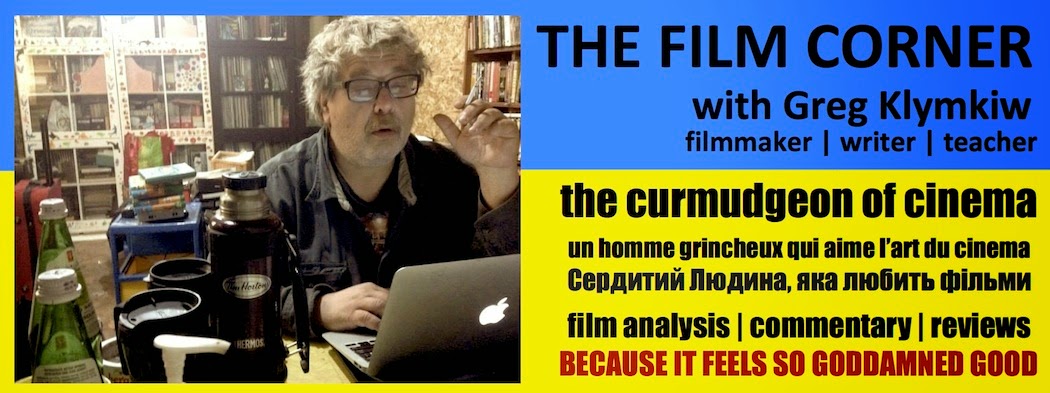
GREG KLYMKIW - THE CURMUDGEON OF CINEMA

Greg Klymkiw’s 35 years in the industry includes journalism, screenwriting, script editing, producing and 13 years of service to the Canadian Film Centre as its senior creative consultant and producer-in-residence. In addition to producing iconoclastic work by Guy Maddin, Cynthia Roberts, Bruno Lazaro Pacheco and Alan Zweig, his legendary guerilla campaigns as the Winnipeg Film Group’s director of distribution and marketing placed prairie post-modernist cinema on national and international stages. In addition to Klymkiw Film Corner, he writes for POV Magazine, Phantom of the Movies' VIDEOSCOPE and, among many others, Electric Sheep - a deviant view of cinema. He's writing a book about screenwriting entitled "Movies Are Action" featuring interviews with some of the world's best filmmakers and he is the subject of Ryan McKenna's documentary "Survival Lessons: The Greg Klymkiw Story". At last count he had seen over 30,000 feature films.

Monday, May 28, 2012

FORTUNATE SON - Review By Greg Klymkiw - This important new personal documentary by Tony Asimakopoulos is a journey into the lives of a Greek-Canadian family that makes for a compulsive, sad, funny and profoundly moving experience. It is NOT to be missed!!!

Fortunate Son (2011) dir. Tony Asimakopoulos

****

Review By Greg Klymkiw
“You can spend the entire second half of your life recovering from the mistakes of the first half.” ― Saul Bellow, Seize the Day
I'm truly blessed to have seen an exciting new film that not only moved me - at first, beyond words - but also inspired a flood of thoughts and memories, which all in some fashion are related to the picture itself, but like any great movie, reached out and touched me in ways that forced me to examine so many elements of my own life. I suspect it will do the same for many, many others who are lucky enough to see it.

When an artist delivers nuggets from their own experience, chances are good they will resonate with most of us. When the work is thematically tied to that of family, it's especially hard-hitting. The best of these works will hit us with a roundhouse blow to the gut.

In recent years, the one genre in film that has the power to do this in ways that most other films can only dream about is the personal documentary, but getting the films made and then, once they're made, getting them to an end-user is the real trick.

When it comes to trends, styles and types of stories told, the movie business can be very fickle. It's not the audiences that are mutable - it's the industry itself - and nowhere does this rear its ugly head more than in the world of documentary. Those who hold the purse strings, those who deliver the product to those who deliver the product to the masses crow on, from season to season about what kind of movie is hot and what's not.

What this really means is that many of these entities are unimaginative, lacking vision and/or just plain lazy.

If a movie is great, people will want to see it. That said, some movies need a bit more elbow grease than others. When I started in the business - particularly in the areas of exhibition, marketing and distribution - elbow grease was, more often than not, the norm. Even schmatta-salesman-styled broadcasters, distributors and exhibitors did what I, and others refer to as, uh, work. In fact, the more challenging a great film was, the more these same individuals attacked their calling with relish.

This past year during the Hot Docs Canadian International Documentary Festival, I spoke with so many filmmakers who talked about the difficulties of getting personal documentaries made. And yes, getting any movie made is difficult, but the general air wafting from the posterior-scented jaw flaps of the powers-that-be to filmmakers with great stories to tell, was that the personal documentary was OUT - unless, of course it had some sort of easily identifiable hook of controversy. Even then, filmmakers who did have this sort of easily-exploitable approach found the financing road difficult due to the collective knee-jerk proclamations of entities bereft of vision.

For me, a documentary with a personal approach - where a filmmaker presents a story close to them, perhaps even about themselves, is filmmaking of both a brave and extremely identifiable order. Their stories often mirror our own - the details might be different, but below the surface, they hit us on emotional and intellectual levels.

The bottom line is that the filmmakers, and most importantly, the end-users, the audience, are the ones who get short shrift when those responsible at decision-making levels are purporting to know what people want. Half the time, they're ill-equipped to know what people want and are looking for easy ways to cover their smelly butts.

A good or great picture will find its audience.

One recent film that demands an audience is a personal documentary by Montreal filmmaker Tony Asimakopoulos. Along with another recent film I've seen (which I'm unable to discuss at this juncture), Fortunate Son is a movie that, for me, resonated on so many levels that I suspect I won't be the only one who is deeply moved by it. While watching, re-watching and thinking about it, I was reminded of so much that was close to me when I saw Asimakopoulos's film.

One thing his movie inspired, not just because of the backdrop of Greek culture, but because of the movie's focus upon the theme of family, is something I hadn't though about for a decade or two.

Specifically, it was this:

I wish I could remember the precise date I saw Greek composer Mikis Theodorakis in concert when he visited Winnipeg in the 1970s, but I think it was sometime between 1972 and 1973 because I went to see him conduct and perform live soon after seeing the 1972 Constantin Costa-Gavras film State of Siege (a movie I loved, with a score by Theodorakis that I loved even more). I also know it was before seeing Sidney Lumet's 1973 Serpico (a movie I loved that hasn't quite stood the test of time, though the Theodorakis score most certainly has).

I remember asking my parents to buy me a ticket to see Theodorakis at the Centennial Concert Hall - mostly because I owned the original vinyl soundtrack recordings to Zorba the Greek, Z and State of Siege. After all, what self-respecting 13-year-old movie geek living in the provincial backwater of Winnipeg would not want to see someone he considered a star. Yes, I had the movie bug so bad, that even as a kid, "stars" to me were not just those in front of the camera, but those behind it.

For some reason I clearly remember it being a Sunday afternoon when I saw Mikis Theodorakis. Live. In-the-flesh. The concert hall was packed to the rafters with Greek-Canadians. There were, however, two Ukrainians in the audience - me and, as I eventually noticed sitting a few rows down, my late Uncle Walter Klymkiw - a great choir master and scholar of Ukrainian Folk Music.

Uncle Walter was kind of a cultural touchstone for me within my ridiculously large extended family of Ukrainians. As a kid, I was always enamoured with his great love and knowledge of literature, theatre and yes, music. Whenever he took the time to engage me in some conversation about something I loved (usually Chekhov, Dickens and Mahler), I'd feel a strange warmth, probably because he was someone who didn't - at least during my childhood - think I was out of my mind for being passionate about something other than the commonplace. (In fairness, my Mom was especially accepting of my obsessions with all things artistic, even if she herself didn't quite get all the obsessions herself and Dad took me to every Peckinpah, Clint Eastwood and John Wayne picture.)

Uncle Walter was family - but not immediate.

This is, perhaps why I get so sentimental when I think about him.

That afternoon at the Centennial Concert Hall was gob-smackingly exhilarating. Theodorakis was not presenting his film scores, but music I'd never heard before - music that chilled me to the bone and perhaps even more so because the audience leapt to their feet after every piece. Electric. That's the only way I can describe it.

I flagged my Uncle down during the intermission. He asked me why I was there. I told him about my love of the Theodorakis movie music and then I asked why he was there. He explained that Theodorakis was a refugee, living in exile away from his beloved Greece where he fought strenuously against a repressive regime. He explained that, like our family - Ukrainians - Theodorakis was fighting for the freedom and culture of his people outside of his own country - Greece.

This definitely struck a chord with me. My own family had numerous founding members of a federation in Canada that was devoted to preserving Ukrainian culture outside of Ukraine as it was being repressed by the Russians after the revolution until the early 90s. (One might say, the repression from Russia is continuing in Ukraine due to the gangsterism of Putin, but that's another story.) In any event, Uncle Walter's revelation to me cast a new light on my appreciation of the second half of the concert and explained the audience reaction in the first half of the concert.

Beyond a new aesthetic appreciation for Theodorakis, I was, even at the time, reminded of the importance of family. A common bond of blood opened my eyes to something new.

Love is a powerful eye-opener and this is what's at the root of Fortunate Son. The above personal memory - a mere shard of my life - came flooding back to me after seeing Asimakopoulos's film, but most importantly, the notion that love and family are why we're all here on this Earth.

Another great thing Fortunate Son reminded me of was Elia Kazan's America America, his great dramatic rendering of his own Greek family's escape from repression in Turkey. This was a movie I'd seen on TV as a kid and I remember what a huge impression it made on me - so much so, that even when I see it now I'm easily able to repress the picture's occasional flaws.

The opening shot of Mount Ararat in Kazan's film seems almost identical to the opening shot in Fortunate Son of a mountain overlooking Azimakopoulos's own parents' Greek village.

In both films, this is an extremely powerful image. It represents an almost pastoral beauty - one that seems to exist in another time and place, but also conjures up thoughts about how far away and seemingly unattainable it is - unless, of course, one chooses the arduous task of climbing it.

For Asimakopoulos and Kazan, their films and the personal tales they tell are not unlike a mountain that must be climbed - to conquer that which seems too formidable, a dragon that must be slain, but requiring obsessive bravery and fortitude to deliver the ultimate blow.

From this opening shot, Asimakopoulos provides a haunting montage of immigrants on a boat, long-ago memories of happy couples celebrating life and love and then juxtaposed with a series of odd, evocative black and white images of a swarthy young goodfella - adorned in a sport coat and staring at himself in the mirror (not unlike that of Jake LaMotta near the end of Raging Bull). The soundtrack to this point has been dappled with its own montage of hollow, barley audible sounds of boats, water, clinking glasses, Greek folk music, laughter and then we get the first words of narration that spell out the journey we're about to take with Asimakopoulos in Fortunate Son.

"Am I a good son?" asks the haunted voice. "Am I a bad son?" And then, in an almost stylized goodfella-from-the-hood fashion: "I dunno."

This is the peak the filmmaker must ascend. We want to immediately to climb it with him. We want to know if he is a good or bad son. We want him to know if he is a good or bad son. And perhaps most indelibly, we're reminded of how all of us wonder the same thing. Are we good kids or bad kids? Are we good parents or bad parents? Are we good husbands and wives or bad husbands and wives?

Or is there no such thing?

Or more truthfully, is goodness found somewhere in the middle - in shades of grey?

The journey Asimakopoulos takes us on makes for a compulsive, sad, funny and profoundly moving experience. We hear about his parents' life in Greece, their immigration to Canada, their life in the New World. We become privy to the story of their roller coaster ride marriage, Tony's childhood, his troubled adolescence and eventual struggle with heroin addiction. We experience his current relationship with his Mom and Dad while also exploring life with his beloved fiance Natalie. We hear and see his parents' patterns of behaviour, both past and present - the laughter, love, tears and conflict. So too do we experience Tony's own love story - fraught with the same emotional challenges that his parents faced and his fear that he is merely repeating the patterns of his life before heroin addiction or worse, the sins (as it were) of his Mother and Father.

Asimakopoulos renders this tale with a skilfully edited blend of archival footage, old home movies, scenes from his student films, experimental work and his first feature film. We get up close and personal shots of his life and that of his parents - deftly interwoven with head-on interviews.

We see the hopes, dreams and lives of a family which, finally, remind us of our own experiences.

At one point Natalie talks about her own parents splitting up and asks Tony about his Mom and Dad. "Do you ever wonder why they stayed together?" she asks.

Without hesitation, Tony responds: "No. Not really."

And for some of us, his response makes perfect sense. Old World families and, to a large extent, previous generations with Old World values might have considered splitting up, but they almost never did. In a sense they're imbued with what I like to think of as the maturity of fortitude.

Yeah, yeah - so life doesn't always deal you the cards you want, but you keep playing the game because whatever losses you might suffer, the elation of the occasional win is too great to give up based upon the whims that so many with New World values and recent generations have inspired.

It's easy to give up, but as Asimakopoulos's film demonstrates, it takes courage, REAL courage to keep going, to keep fighting the good fight, to never say never. (Kind of like the aforementioned film industry decision makers - it's easier to say "No" than have the courage to say "Yes" when something seems difficult.)

This might be the genuine importance of Fortunate Son - it demonstrates the inescapable truth that love is not easy. For love to BE love, for love to really count, it takes work, courage and fortitude. It means giving up ephemeral happiness for that which really counts - the happiness of endurance, of perseverance, of never giving up.

This is ultimately, the importance of family. (Or, in the words of a character in Peckinpah's Ride The High Country: "I want to enter my house justified.")

And sure, Asimakopoulos details what many of us, and even in his own words, describe as "dysfunctional" families. Yeah? So what? All families are dysfunctional to one degree or another.

Again, all that matters is love and family.

Is Tony's Mom seen as over-protective, over-bearing and even judgemental?

Hell, yes.

Who isn't?

At one point, his Mom talks about Tony's fiance and declares: "I prayed you would find a nice girl and we found her, didn't we?"

Some might see the use of "we" as taking a degree of empowerment away from her own son, but does, in fact, present the fact that "we" are all in this together and that for all the trials and tribulations, family reigns supreme.

When Tony talks about kicking his heroin habit, we hear his addiction counsellor well-meaningly talk about Tony's need to get away from the shackles of the family unit. "You needed to get unhooked," he says of Tony leaving his family and while this was a good band-aid solution, we see repeatedly how it's love and family that truly saves the day.

When Tony accompanies his parents to their hometown in Greece, we get glimpses of what life and family was like back in their early years. Family and just how needy family can be is a truth that's both funny and moving.

Tony's Dad (who left Greece in 1967 during the beginning of the junta that Theodorakis fought against) jokes about how every time he went back to Greece to visit his mother, she'd cry and declare how old she was getting and how this would be the "last time" he'd ever see her again. He and Tony laugh good-naturedly when he reveals she said the same thing repeatedly over numerous trips back to see her.

Tony's Mom, on the other hand, paints an entirely different portrait of her connection to Greece and family. At one point, she finds a stone on the ground and thinks it might be nice to take this piece of Greece back with her to Canada. She thinks on it, then places the stone back, saying: "The rock will cry if I take it away from its home."

She sounds like my grandmother.

When she visits her Mother's spartan bedroom - preserved almost like a shrine, she finds some sacred religious artifacts that belonged to her Mother. She firmly declares that she will not leave them behind. "It would be a sin to do so," she says.

Later on, Tony's Mom reveals that she wanted to go back home, but that it was marriage to Tony's Dad in Canada that dashed those dreams. She does not say this with bitterness or regret, but with the aforementioned maturity of fortitude. When she discusses her Mother in Saint-like terms - a single mother who worked herself to the bone to feed her family - she begins to tear-up. Thinking about how much her mother sacrificed for her and how she eventually got sick and died alone is almost too much for her to bear.

As it would be for anyone.

And often, as personal films can do, Fortunate Son takes a turn in the story of this family when his Dad is diagnosed with stomach cancer and we witness the family's terrible and brave struggle to deal with this. Even here, however, there's a mixture of sadness and humour (as typified by the title of Armenian-American William Saroyan's great book and film, "The Human Comedy"). Here's Dad - seriously ill with stomach cancer - and Mom is piling heaps of artery-clogging food on his plate (something Ukrainians understand all too well). Mom even complains she's screwed the food up and heaps salty slabs of cheese on it.

"Put on some Feta to make it taste better," she offers.

And yes, food is very important to this family. We see one scene after another round dinner tables - piled high with culinary delights that watered this Ukrainian's mouth like a geyser. Early in the movie, Tony's Dad is leaving to play cards at the local Greek community bar. Tony's Mom gives him the most delectable list of food to bring home from the grocery store. Towards the end of the film, fearing her husband might die, she reveals to Tony that "I want to die before your Father does. It's better that way." Then she adds: "Because he can take care of himself."

At this point (along with many others in the movie), tears erupted from my eyes.

All I could think about was this: "Who would bring groceries home for her if her husband died first?"

It's a question all of us would ask in similar situations. The details might be different, but the sentiment is the same.

Tony Asimakopoulos is one of Canadian cinema's great unsung talents. His early student films and experimental works and first feature are brimming with a voice that needs to be heard. His work has been charged with a unique underground flavour - a kind of Greek Scorsese boys in the hood quality of obsession with dapplings of George Kuchar melodrama and lurid high contrast visuals. He's taken this style and while not completely abandoning it, he has developed and matured into a fine cinematic storyteller.

Fortunate Son is, quite simply, a genuinely great film.

It's a movie that everyone must see.

And yeah, I can think of a few Greeks who might love it too.

"Fortunate Son" will play theatrically at Montreal’s Cinema ExCentris (3536 Blvd,St.Laurent) on June 1-3, 2012. The film is in English & Greek, with English & French subtitles. For showtimes check the Excentris website for screening times HERE. Additional playdates in Canada throughout the next few months can be accessed by visiting the EYESTEELFILM website HERE.


Thursday, May 24, 2012

Toronto's ROYAL CINEMA has some terrific movies this week - If you haven't seen them on a BIG SCREEN, you miss them at your peril - especially given the fact that the Royal has one of the finest projection and sound systems in town. HARD CORE LOGO with HARD CORE LOGO 2, THE DEEP BLUE SEA and CORIOLANUS - All Reviewed Here By Greg Klymkiw


The Deep Blue Sea (2011) dir. Terence Davies
Starring: Rachel Weizs, Simon Russell, Tom Hiddlestone

****

By Greg Klymkiw

I used to think Terence Davies might well have been one of the most important living British filmmakers. I was wrong. He is, without question, Britain's most important living filmmaker. From his trilogy of mesmerizing shorts to his latest work, The Deep Blue Sea, Davies is easily as important to the framework of Great Britain's cinema heritage as Michael Powell and Emeric Pressburger or any of the greats of the 1960s British New Wave.

Working in a classical style with indelible compositions, creating a rhythm through little, no or very slow camera moves and infusing his work with a humanity seldom rivalled, Davies recognizes the importance of cinema as poetry – or rather, using the poetry of cinema to create narrative that is truly experiential. (I doubt any audience member will forget the haunting underground tracking shot during the Blitz in this new picture – as evocative to the eye, ear and mind as anything I’ve seen.)

I’d go so far as saying that Davies might well be the heir apparent to film artists like Alexander Dovzhenko and Sergei Paradjanov – exploiting the poetic properties of cinema in all the best ways.

The Deep Blue Sea is a heartbreaking, sumptuous and tremendously moving adaptation of Terrence Rattigan’s great play of the same name. Rattigan’s theatrical explorations of class and sex have made for rich film adaptations, most notably The Browning Version, Separate Tables, The Winslow Boy and The Prince and the Showgirl. Rattigan, given the discriminatory criminalisation of homosexuality in England (his frequent collaborator, the closeted director Anthony Asquith, was the progeny of the man who signed Oscar Wilde’s arrest warrant) chose to primarily reflect on gay issues and culture by utilizing a critical dramatic look at the often troubled lives of straight couples.

Nowhere is this more powerfully rendered than in The Deep Blue Sea, which Davies has adapted with considerable homage to the play’s tone and themes while using the source as a springboard for his own unique approach to affairs of the heart. (While Davies oddly reduces the role and importance of the play’s one clearly gay character, one suspects he did this to focus more prominently on the trinity of its central characters.)

Here we feel and experience the tragic tale of Hester (Rachel Weisz), who leaves her much older, though loving husband, the respected judge Sir William (Simon Russell) when she meets the handsome, charming Freddie (Tom Hiddlestone), a former RAF pilot who allows her the joys of sex for the first time in her life.

Alas, Freddie’s a bit of a rake and soon tires of domesticity, and Hester is driven to seriously contemplating suicide. Sir William wishes desperately to have her back. The eternal dilemma is that Freddie doesn’t love Hester as much as she’d like, nor does Hester feel as much love for Sir William as he does for her.

This is a beautifully acted piece through and through. Most astonishing is the performance Davies coaxes out of Rachel Weisz - it's as infused with heartbreaking tragedy as the great work he pulled from Gillian Anderson in his perfect film adaptation of Edith Wharton's The House of Mirth.

The triangle in The Deep Blue Sea is played out with Davies’s trademark style and a welcome return to pubs thick with smoke and filled with songs sung by its inebriated denizens. Harking back to Distant Voices, Still Lives, the songs here are not so much a counterpoint to the drudgery of the characters’ lives as something indicative of an overwhelming malaise born out of repression and class.

Davies dazzles and moves us with his humanity and artistry.

It doesn’t take much to give over to his stately pace, and when we do, we’re drawn into a world that can only exist on a big screen, while at the same time providing a window on the concerns of days gone by that are more prevalent in our contemporary world than most of us would care to admit.

"The Deep Blue Sea" is currently in theatrical release via Mongrel Media and in Toronto is playing at the Royal Cinema. For information on showtimes at The Royal, click HERE


**********************************************************************************

Coriolanus (2011) dir. Ralph Fiennes
Starring: Ralph Fiennes, Gerard Butler, Brian Cox, Vanessa Redgrave, Jessica Chastain, James Nesbitt, John Kani, Paul Jesson

***1/2

By Greg Klymkiw

"What's the matter, you dissentious rogues
That rubbing the poor itch of your opinion,
Make yourselves scabs?"
(I.i.150-152) - William Shakespeare, Coriolanus
Coriolanus: My name is Caius Marcius,
who hath done to thee particularly...
Great hurt and mischief;
thereto witness may
My surname, Coriolanus.

Butt-head: Huh huh huh. He said, "Anus."
Beavis: Coriolanus. Anus. Oh, yeah.
Butt-head: Uh, yeah. Anus.
Beavis: Yeah, yeah. Yeah, I heard it, too. Anus.
Coriolanus: The extreme dangers, and the drops of blood
Shed for my thankless country are requited
But with that surname -- a good memory.

Butt-head: What a dork.
- With Apologies to William Shakespeare and Mike Judge

Ralph Fiennes, easily one of our greatest living actors, makes an impressive feature film directorial debut with this action-packed Paul (Bloody Sunday, United 93, The Bourne Supremacy) Greengrass-like political thriller. That it's a superb, vibrant and topical adaptation of William Shakespeare's great tragedy Coriolanus is a double-layer of icing on the cake. It's an extraordinarily riveting feast for the mind and senses.

The phenomenal screenplay adaptation by John Logan (Hugo, Rango, Sweeney Todd, The Aviator) retains the glorious iambic pentameter styling of Shakespeare's rich dialogue (with de rigueur, though always exceptional cuts to the Bard of Avon's text) and sets the action in a contemporary (or very near future) Rome. Given the current financial crisis worldwide (and in particular, the utter mess Italy is currently mired in), as well as the war-zone that our world has become thanks to George W. Bush, Logan's script and Fiennes's first-rate direction of it, delivers a movie that's not only relevant to the here and now, but is proof-positive of the universal qualities inherent in great writing - no matter where and when it's written. (This movie, along with Roman Polanski's Macbeth is a sure-fire way to get any doubting-Thomas high school student - or, for that matter, just about anyone - to devour Shakespeare ravenously.)

The film is set in a Rome that has degenerated into the sort of fractioned warfare that plagued (and continues to plague) many of Europe's Balkan countries. Caius Martius Coriolanus (Ralph Fiennes) is a great warrior who has brought glory to Rome in a battle with a breakaway revolutionary force led by Tullus Aufidius (Gerard Butler). Loyal to the State to a fault, he's not done himself any favours by exerting brute force on his own people who, during the war, have been starving while stores of grain have been guarded fiercely by the forces of Coriolanus.

When our hero is offered the position of consul, he maintains his stance as a warrior, refusing to play any political games. Unable to "lower" himself to currying favour with Rome's populace, several treasonous power-hungry tribunes and senators seize this opportunity to slant things against our hero and force him into exile. Burning with rage, Coriolanus joins forces with his previous nemesis Aufidius (an equally great warrior) and together they march on Rome, decimating everything in their path.

This is quite a magnificent picture. The battle scenes are unremittingly chaotic, violent and alternately sickening and exciting. Fiennes makes excellent use of cinematographer Barry Ackroyd (The Hurt Locker, Green Zone) whose whirly-gig camera captures the battlefields of both the war zone and the political arena. Veteran editor Nicolas Gaster keeps things moving with verve while the superb percussion-heavy score by Ilan Eshkeri (Kick-Ass, Centurion) adds drive, emotional/dramatic context and flavour to the proceedings.

Blending newsreel footage with TV roundtable interviews and straight-up drama, Shakespeare's period dialogue never feels incongruous with the contemporary setting and storytelling techniques. Fiennes elicits phenomenal performances from his key cast - notably the great Brian Cox as the loyal, but doomed Menenius and an astounding Vanessa Redgrave as Volumnia, the manipulative Mom of Coriolanus.

Given that he's both behind the camera and in-front of it for so much of the film's running time, his own work as an actor never suffers. It's great looking at Fiennes's aquiline facial features and listening to him spit out his lines as if his life depended on it.

Cast-wise, the revelation here is probably Gerard Butler. I've always had a soft spot for him as an actor - especially in his kick-butt action pictures like 300 and RocknRolla, but as Fiennes' nemesis-turned-ally, he acquits himself with skill and power. His explosive line readings as Tullus Aufidius knocked me on my ass and I loved it when his Scottish brogue kicked in on overdrive.

The movie is full of great touches, but one of the more powerful moments is when Fiennes has his head shaved into full-on warrior-dome and all his men follow suit. They become an army of skinheads - bent on bloodlust, pillage and vengeance. This is what happens when men of action are betrayed by weaselly bureaucrats and it ain't a purty sight.

I had a few minor quibbles with Fiennes's mise-en-scene. While the Greengrass-like herky-jerkiness is well handled and quite appropriate for much of the action, there's a great moment where Coriolanus demands mega-mano-a-mano with Tullus Aufidius. The movie primes us for one major kick-ass head-stomper of a fight between Fiennes and Butler. Alas, where Fiennes errs as a director is continuing the herky-jerky rather than trusting in the clearly superb fight choreography.

There's also one unfortunate God's-eye-view longshot of the market when Coriolanus is led to address the "rabble". Given the care taken to make the multitudes look old-movie-style gargantuan, we unfortunately see less people on the periphery than we should. Nitpicky, yes - but so much of the movie is so good, less-than-stellar moments stick out like sore-thumbs.

Finally though, Coriolanus rocks bigtime! We get a great play rendered magnificently by a first-rate cast and one setpiece after another to remind us of the urgency, importance and magic of movies - and most of all, that of William Shakespeare.

Coriolanus is nothing if not cool, and it sure isn't nothing and it's most certainly cool.

"Coriolanus" is presented in Canada via D Films and for showtime information at the Royal Cinema in Toronto, click HERE.


**********************************************************************************


Hard Core Logo II (2011) dir. Bruce McDonald
Starring: Bruce McDonald, Care Failure, Julian Richings, Shannon Jardine, Peter Moore

****

By Greg Klymkiw

I have to admit that part of my favourable response to Hard Core Logo II is strictly on a personal level. Firstly, my inauguration into the canon of director Bruce McDonald was Roadkill, his crazed rock and road odyssey through Northwestern Ontario. It was the fall of 1989 and during the last year in which I was writing about films. And I really did love writing about movies. I'd been doing so since the late 70s, but I was about to turn a corner in my life and this part of it would be ending a few months or so later.

At the time I was attending the Toronto International Film Festival (TIFF) and in addition to doing some marketing work on behalf of the film co-operative The Winnipeg Film Group, I was moonlighting as a writer for the now-defunct "Cinema Canada" magazine and was presented with the task of reviewing McDonald's movie. It wasn't hard work at all. It was a terrific picture and my delight with it poured from my soul and through my fingertips and into my word processor like shit through the proverbial Canadian Goose.

At the time it reminded me of both David Lynch's Eraserhead and Allan Arkush's Rock n' Roll High School - hypnotic, dream-like, gloriously black and white, energetic, madly nutty,laugh-out-loud funny and pure rock and roll joy.

I've seen it a few times since and I stand by this assessment.

And goddamn! Roadkill was as Canadian as a fucking beaver pelt adorning Norman Jewison's pate. Every surreal moment from my punk years in Winnipeg seemed to spring miraculously to life. Endless nights in dark, now-defunct watering-holes like the "Native Club", "The Royal Albert Arms" and the basement of the "St. Charles Hotel" (AKA "The Chuckles") - seeing everyone who passed through (early XTC, the Popular Mechanix, the notorious rape-rockers The Mentors) to insane seven-hour drives to Thunder Bay to listen to heavy metal bands (often of the local variety) at the Inn-Towner - that miraculous dive where every chick had hair permed-out like Medusa which, under black light it glowed with an almost radioactive "buy-me-some-fuckin-beer-and-maybe-we-can-fuck-eh" come-hither-with-a-stubby quality.

I felt as if I had died and gone to Heaven.

From here I followed Bruce's films passionately. Most of them I loved, some of them I liked and a number of them had me scratching my head with a kind of what-in-the-fuck-are-you-doing-you-psycho response. In 1996, when I saw his Hard Core Logo, which I loved, I remember being swept away by this road movie involving the crazy punker Joe Dick and his band on a comeback tour through the western prairies of Canada and was convinced McDonald would never top the film.

I was wrong, of course. Throughout the years he delivered one terrific picture after another - most notably his brilliant zombie picture set entirely in a rural radio station Pontypool and his truly whacked adaptation of Maureen Medved's novel The Tracy Fragments. The only film of his I didn't see was the notorious Picture Claire. At TIFF it was screening while 9/11 was happening. The night he was showing his "director commentary" cut at the Bloor Cinema, I was in Winnipeg. I'm cool with that. Every director I love has one or two "Holy Grail" pictures that I hope to partake in someday.

So let's fast forward to the present and how seeing Hard Core Logo II hit me where all the best movies should - on a personal level. Firstly, I bring you back to my own personal full-circle coincidence of HCL II being the first McDonald movie I've seen to write about since I stopped writing about movies. And yeah, here I am, 23 years later, back to the future, so to speak - again writing about movies (amongst other writing chores like screenplays and a text book). I have to admit to a certain sentimental attachment going in to seeing HCL II on this level.

Beyond that though, is the personal relationship one forges with certain artists and their art. Bruce was born about a month after me in the same year. He was born in Kingston and grew up in Scarborough. I was conceived in Detroit and born/raised in Winnipeg. Same difference, really. For many years, without knowing each other in any way, shape or form, we grew up with similar interests and experiences. On that level alone, he's a filmmaker who spoke to me as a contemporary and I've lived through 23 years of his work - connecting aesthetically, but also personally - his work seeming to almost umbilically connect to my very being.

This, I'd say, IS extremely important. When a filmmaker connects with audiences on this level, then truly this is an artist worth studying and revering. However, it's especially noteworthy that his work connects with me as a Canadian with shared experiences.

Hard Core Logo II is NOT a retread or reboot. It IS, a sequel. HCL I, a clever mock-doc wherein the lead character blew his brains out on-camera at the end seemed pretty much sequel-proof. What McDonald does, however, is turn the next phase of the tale into a semi-personal and quasi-fictional mock-doc - focusing on the character he himself played, "Bruce" the filmmaker.

And here, 23-years later, "Bruce" is working successfully in American television. He's the creator and director of "The Pilgrim", a ridiculously popular Christian western aimed squarely (and somewhat cynically on the part of the fictional/actual filmmaker) at the moronic religious right. When the star of the series Rufus Melon (a brilliantly scuzzy and hilarious Adrien Dorval) is caught in a horrendous sexual scandal, the show is immediately cancelled and Bruce is without a job.

Where he'd previously been ignoring reports that rock singer Care Failure (played, no less, by Care Failure of "Die Mannequin" fame) has psychically channeled the spirit of the late Hard Core Logo frontman Joe Dick, "Bruce" now drops everything to make a new documentary to reclaim his former glory as an independent filmmaker.

Going the super-kamikaze filmmaking route, he leaves his wife and child home alone and brings along only one crew member - his next door neighbour, the completely bonkers New Age Wiccan video/performance artiste Liz (Shannon Jardine). She mans, as it were, the camera, while he records sound, directs and interviews. He's promised Liz a co-directing credit, but as his personal notes reveal later on, he just needs (and treats her) as a glorified schlepper.

The two of them follow Care to Saskatchewan where she will record a solo album under the guidance of Joe Dick's former mentor Bucky Haight (Julian Richings, repeating his original HCL role and astoundingly proving again why he's one of Canada's greatest character actors).

McDonald and his co-writer Dave Griffith put together a number of scenes which give a strong sense of the drudgery and boredom involved in producing an album but when things threaten to get a bit too languid, we're tossed a few phantasmagorical montage sequences (something McDonald has been obsessed with in his latter output and which are handled with aplomb by editor Duff Smith). These insane patchwork quilts of exorcism, talking animals, flashbacks to Joe Dick blowing his brains out, etc. are worthy of such 70s and 80s head films like Alejandro Jodorowsky's The Holy Mountain and Slava Tsukerman's Liquid Sky.

The dreary Saskatchewan locations also add considerable Canadian chic to the whole affair. I used to think, for example, that looking at the topography surrounding my old hometown whenever I landed in a plane at the Winnipeg International Airport was the most depressing thing in the world. Hard Core Logo II reminded me that NO - landing at the Regina Airport is far more soul-sucking.

We're guided through this oddball low-key tale, contrasting nicely and unexpectedly with HCL's raging drive, through the laid-back journal entries of filmmaker "Bruce". If anything drives the engine of this happily sputtering engine it's exploitation.

Because this is a Canadian film in a Canadian setting with Canadian characters - the exploitation is, not surprisingly, Canadian. That is, characters gently, subtly remind each other how much they're exploiting each other. McDonald's film captures this exploitation ever-so subtly.

There are the newspaper clippings accusing "Bruce" of exploiting Joe Dick from the original film. There's the implication that Care is exploiting the memory of Joe and furthermore, by possibly pretending to be possessed to get "Bruce" to make a film about her. Bucky accuses "Bruce" of exploiting Care. "Bruce" accuses Bucky of exploiting her. Care accuses both of them of exploiting her. "Bruce" and Bucky gently suggest mutual exploitation of the dead Joe Dick. "Bruce" is clearly exploiting the mad schlepper Wiccan and even the disgraced actor Rufus Melon shows up to exploit "Bruce", in order to party with Care and to get a guest spot with CBC's "Strombo" to declare his "healing".

Gentle, subtle exploitation is always the Canadian way. Canadians prefer smiling and alternately stabbing in the back - gently. They almost never look someone squarely in the eyes to gut them.

And within the context of the world McDonald creates - nobody (much like Canadians in reality) seems to want anything of any real import.

Except for one thing.

And this is the surprising, profoundly and deeply moving aspect of Hard Core Logo II. When it is determined what is truly important, a sacrifice is made - one which takes us into an afterlife and where the spirit of love and of family overtakes and overwhelms us.

I must admit to being taken completely off guard here. I should have seen it coming, since the film is strangely bookended with something so uniquely personal that it's often the element that - subtly - sneaks its way through the entire film. And when this sequence occurs, I must admit that I was touched emotionally in ways I never expected. It's both a heartbreaker and a spirit-lifter.

The movie begins, builds and ends with a humanity that's been hinted at in some of McDonald's earlier work, but explodes in ways that will, I think, especially touch a particular generation of Canadian with an equally particular series of experiences.

The movie is probably not for everyone. Those expecting a replay of McDonald's earlier successes will be denied an easy road. He delivers an offbeat journey and one that perfectly exemplifies a segment of the punk generation - that generation (especially, I think, in Canada) that sprouted at the tail-end of the baby boom and created a whole group of rebels who existed between the hippie sellouts and the Gen-X McJobbers.

The real rebels. Those who truly had to pay a price for their ideals and in so doing, continue to clutch desperately and/or longingly at those things everyone thinks they want, but for this generation, when they discover that wondrous thing, they know it's exactly what makes life worth living.

"Hard Core Logo II" is playing at the Royal Cinema on a double bill with McDonald's "Hard Core Logo". It is being released by Alliance Films. For information on showtimes at The Royal, click HERE.


Wednesday, May 23, 2012

CLOUDBURST - Review By Greg Klymkiw - DO NOT MISS Thom Fitzgerald's hilarious AND moving love story at Toronto's Inside Out LGBT Film Festival on Friday, May 25, 7:15pm at TIFF Bell Lightbox


Cloudburst (2011) dir. Thom Fitzgerald
Starring: Olympia Dukakis, Brenda Fricker, Ryan Doucette, Kristin Booth

****

By Greg Klymkiw

"They danced down the streets like dingledodies, and I shambled after as I've been doing all my life after people who interest me, because the only people for me are the mad ones, the ones who are mad to live, mad to talk, mad to be saved, desirous of everything at the same time, the ones that never yawn or say a commonplace thing, but burn, burn, burn like fabulous yellow roman candles exploding like spiders across the stars and in the middle you see the blue centerlight pop and everybody goes 'Awww!'" - Jack Kerouac, On The Road

The open road is freedom, but in reality and in the best popular culture, there is always a point where one must reach the end of the road. Sometimes it's sad and empty, sometimes it's not what you expected, often it's bittersweet. Whatever lies at the end of the journey, it's the ride that should always be the thing. It's what you discover and celebrate on the road that is often far more important than what's waiting there (if anything) when it ends.

Stella (Olympia Dukakis) and Dot (Brenda Fricker) have lived an incredible journey of love and mutual respect as a couple for over 30 years, but when circumstances seemingly beyond their control threaten the joy and happiness they've had, the open road becomes the only real way to obtain a pot of proverbial gold at the end of a new journey.

Family, it seems, is not always defined by blood - it takes love - and for this couple, family comes in the unlikeliest of places and circumstances. Love is what defines lives well lived and this couple have had love in spades, but in order to keep it unfettered from the unwelcome intrusion of a well meaning, but completely out-to-lunch blood relative - public affirmation becomes the ultimate goal. They must marry.

The problem is that they live in the United States and can only gain the legal status as a married couple in Canada. What's a foul-mouthed, cowboy-hat-adorned, k.d. lang-obsessed, self-described old dyke and her jolly, sweet, visually-impaired longtime companion to do? What would you do? Me, I'd hop in my half-ton pickup truck, stock it with k.d. lang CDs, pick up a hunky male hitchhiker headed to visit his ailing Mom in Nova Scotia and cross the 49th parallel to get myself good and hitched - kind of like Stella and Dot do in the lovely, funny and touching new film written and directed by Thom Fitzgerald.

Cloudburst is a movie that needed a deft directorial touch and a script that could take the cliches normally associated with road movies and generate truth, humanity and humour and thankfully, for the most part it succeeds in this regard.

For years I kept wondering when director Thom Fitzgerald, who made one of the most thrilling feature debuts of the 90s, The Hanging Garden, was going to generate a picture that fulfilled the considerable promise displayed in that exquisite heartbreaker of a movie. This is not to discount the intervening years of work, but Cloudburst feels like a return to form and, on occasion, a step or two forward.

Olympia Dukakis and Brenda Fricker are tremendous actresses, but given the emphasis these days upon demographics and the usual requirements from studios and other financiers to cater exclusively to younger audiences, the number of great roles for talents in this august age group are getting fewer-and-far-between-er. Fitzgerald crafted two roles that any great actress would love to sink her teeth into and frankly, Dukakis and Fricker are so captivating, moving and funny, I have to admit it feels like they were born to eventually step into these parts.

Set against the lush, superbly photographed backdrop of Nova Scotia, Fitzgerald took this story, a sort of gentle retirement-age Thelma and Louise, and both wisely and bravely delivered a tale that's as mature as it's downright universal. Love should have no boundaries and his direction indelibly captures a love story that's familiar, but bolstered by such genuine compassion, that I frankly can't imagine any audience not succumbing to it's considerable charms.

There are a few overwrought moments of humour that try a bit too hard, but for the most part, I found myself laughing heartily and genuinely and damn it all, I shed more than a few tears.

It's one of the few unabashedly sentimental celebrations of love I've seen in quite some time. The picture wears its heart proudly on its sleeve and while there's something just a little bit old-fashioned about that, Fitzgerald handles the proceedings with such grace, that everything old becomes happily new again. Some might choose to deny the power of sentiment, but they'd be lying (or just plain foolish). We all need sentiment from time to time and Cloudburst is the right time, the right place and just the right film to make us all feel grateful for the joy that life, with all its ups and downs, bestows upon us and hopefully prepares us for whatever journey we take beyond the end of the road.

"Cloudburst" is playing at Toronto's Inside Out LGBT Film Festival on Friday, May 25, 7:15pm at TIFF Bell Lightbox . For more information, visit the festival's website HERE.


Here are some Thom Fitzgerald movies you buy directly from here (and support this site) via Amazon.com and Amazon.ca:


Saturday, May 19, 2012

LA HAINE - Review By Greg Klymkiw - The classic 1995 depiction of life in the banlieues of Paris is now available on a magnificent Blu-Ray from the Criterion Collection. The movie is as vital now as it ever was and the package includes a cornucopia of fabulous features to enhance your experience. This is a must-see, must-own work of art!


La Haine (1995) dir. Mathieu Kassovitz

Starring: Vincent Cassel, Hubert Koundé, Saïd Taghmaoui

****

Review By Greg Klymkiw

La Haine was theatrically released 17 years ago, but feels like it could have been made yesterday. Mathieu Kassovitz's rage-fuelled portrait of violence and poverty in the housing projects of Paris within the above-ground-catacomb-like banlieues, pulsates with the raw energy of late-60s-early-70s political thrillers by the likes of Costa-Gavras, but is also charged with the same slice-of-life energy the young Martin Scorsese brought to bear in Who's That Knocking At My Door and Mean Streets.

On the surface, we have the simple tale of three best friends living in the aforementioned slums who have all been affected in different ways by a massive riot kicked off when the police, in a racially-motivated act of thuggery, beat a young man who now lies in a coma and possibly near death. Kassovitz follows Vinz (Cassel), Saïd (Taghoumi) and Hubert (Koundé), a Jew, an Arab and French-African respectively as they encounter a series of prejudicial harassments by the police as they semi-aimlessly attempt to get through a day just after the banlieues have been besieged by the carnage.

The young man who was murdered was a close pal of Vinz and when he finds a .44 Magnum lost by a cop during the urban mêlée, he hopes to gain neighbourhood "respect" by vowing to kill a cop in retaliation. Hubert is a sleek, powerful, though gentle boxer who's managed to make a place for himself in the world by owning a gym, but overnight he's become a member of the disenfranchised once again as his pride and joy has been gutted by a riot-enflamed fire. Saïd longs to escape life in the slums, but also feels powerless to truly leave them and his immediate aim is to collect a debt from a mid-level drug kingpin.

Kassovitz, though he shot in colour, exposes and filters all his shots for black and white, which the film was eventually released on. Though it's not "true" monochrome, it comes damn close and most astoundingly, though he has chosen to shoot handheld, there's not a single shot that isn't superbly composed. Even more thrilling is that it's seldom handheld in the whirly-cam-herky-jerky miasma so popular in low budget films and most annoyingly, in mega-budgeted contemporary blockbusters, usually from directors with no eye who attempt to be cool and "cinematic" (and sadly, manage to pull the wool over the many eyes of both public and critics).

The blocking and use of actual locations is masterly - all the more astounding as Kassovitz was in his late-20s when he made this film. Within the magnificent compositions, the movements of those in-frame and the camera itself are always rooted in both dramatic beats and emotion - no fakery or fancy-schmancy here. Kassovitz has nothing to prove other than to expose the lives of the people who live in the banlieues in a vivid, vital fashion.

Even more stunning is how the youthful helmer handles a sequence where the trio "journey" to Paris. Reminiscent, though not "borrowed" from The Warriors, Walter Hill's amazing 70s kaleidoscope of never-never-Land gang violence, the point of view feels so true to the experience of the characters - allowing us to feel their own wonder and amazement at being transported into the urban bustle of Gay Paree. The various neighbourhoods in Hill's film felt like distinctively different worlds and not in the same city at all - so too is this captured by Kassovitz in La Haine.

In the banlieues, we are so immersed in an immediacy and reality, it feels like Kassovitz was born and raised there (which he wasn't, though he and his team spent a considerable amount of time living there prior to shooting).

His entire cast, including many non-actors from the banlieues is always first-rate, but the revelation upon the film's initial release and astounding even now is the controlled intensity of the brilliant Vincent Cassel (most notably and recently seen as the equally intense ballet impresario in Aronofsky's Black Swan).

Head-on, Cassel is a triangle-domed seething dragon - his enormous crown holding globes for eyes - watery worlds casting roiling seas of hatred upon us and all who dare look upon him. In profile, he's like a bald eagle crossed with a sort of punk extra-terrestrial je ne sais quoi who would, if he had any, eat his newborn straight from the stirrup-spread loins of mummy - making sure to savour as much of the glistening blood and globs of afterbirth with Mephistophelian relish.

His idol is none other than Travis Bickle, DeNiro's psychotic cabbie in Scorsese's Taxi Driver. His recreations of the "Are you talking to me?" mirror sequence chill to the bone. Many filmmakers have, over the years, referenced Scorsese, but save for Boogie Nights, most of these sequences feel more like homage than story and/or character beats. Here again, it's rooted completely in the world of the film. Someone like Vinz - not only in the 90s, but frankly in any age beyond the 70s would, to varying degrees choose someone like Travis Bickle to idolize.

This, finally brings us to the truly staggering genius and power of La Haine proper and its vitality to both the generation it represents and subsequent generations. The movie on every level is timeless and I suspect its importance to both film art and society at large will continue to live and breathe for years, if not decades to come.

The gap between rich and poor as presented by Kassovitz feels no different than what faces the world today and in fact, has become wider and will frighteningly continue to do so. At any stage I suspect his great picture will always feel modern - his classical style adorned with the flourish of cinéma vérité and its shattering portrait of have-nots within a police state makes it then, now and forever a universal work of art.

Some have suggested (always in positive terms) that the film's ending is ambiguous. If you watch the film with open eyes, you'll see this is absolutely not true. A pair of eyes close in the final frames, but in so doing reflect the sad truth for many of us - that no matter what our dreams might be in this world of shit we live in, what we see is what we get.

La Haine sees what we all see, or what we choose not to see.

The picture is definitely headed for masterpiece status.

"La Haine" is currently available in a brand new and phenomenally sumptuous visual rendering on Blu-Ray from the virtually untouchable Criterion Collection. It's accompanied by a number of interesting features which I urge you to watch AFTER you see the movie (even if you HAVE seen the movie before). It's best to let the picture work its magic upon you before diving into the goodies provided. One of my favourites is actually an introductory message from actor-director Jodie Foster who so loved the film that she bankrolled and masterminded its journey to North American audiences in the 90s. (It did extremely well, grossing about $300,000 which 17 years ago was pretty astounding for a black and white French film of such dark subject matter.)

Foster's perceptions are on the money, but it's also wonderful to experience her clear and genuine love for the movie. It's exciting and kind of infectious. And not to belittle her words or intelligence, but it seems like she harbours a mad crush on Kassovitz. The transfer was supervised and the entire edition is one of Criterion's Director-Approved editions. Other wonderful features include a commentary track, a solid documentary on the film, a featurette on the banlieue, production footage, deleted and extended scenes all accompanied by Kassovitz rendering after-comments, the usual array of photos and trailers, plus a terrific booklet, the highlight of which is an appreciation by Costa-Gavras himself.

What's really odd is that the movie was never released on DVD and only available on VHS. Happily, Criterion remedied this situation a couple of years ago and now, we have an even superior home format to see the movie on. This movie, however, is NOT worth renting, downloading, streaming, netflixing or any other inferior method of delivery. JUST BUY IT!!!


Feel Free to support this site by purchasing "La Haine" from Amazon.com or Amazon.ca with the handy dandy links below:


Friday, May 18, 2012

ON THE BOWERY - "The Films of Lionel Rogosin Volume 1" - From the visionary Milestone Films - Review by Greg Klymkiw - Anyone who cares about cinema will add this important work to their collection. Rogosin gave a powerful voice to the disenfranchised, paved new roads for cinéma vérité and inspired subsequent generations of filmmakers.


On The Bowery (1956) die. Lionel Rogosin
Starring: Ray Salter, Gorman Hendricks

*****

By Greg Klymkiw
"Rogosin is probably the greatest documentary filmmaker of all time." - John Cassavetes
"Postwar America experienced a dramatic economic expansion, sustained prosperity, and a huge population increase. By the 1950s, the United States ... manufactured half the world's goods, possessed over 40 percent of the world's income, and had by far the highest standard of living."- National Archives, USA
Postwar prosperity in America is a myth - bought and paid for at a very dear cost to a generation of forgotten men. This had far-reaching implications upon future generations and the nation as a whole. The ramifications of a somewhat spurious development of a middle class are felt today in ways the American people probably never imagined.

Not even in their wildest dreams would anyone have conjured the near-dystopian widening between rich and poor that's so prevalent in today's America. It's a history of building up a teat-suckling dependence upon greed and waste on the backs of those most vulnerable and susceptible to exploitation. During the early post-war era, this facade-of-plenty engendered escape in bottles of cheap booze and a class of working men who were sneered at - if and when they were noticed or remembered at all.

Cinema and indeed, mankind as a whole, owes a debt of gratitude to the late filmmaker Lionel Rogosin. Inspired by the Italian neorealist movement and in particular, the work of Vittorio (Bicycle Thieves) DeSica as well as the groundbreaking docudrama work of Robert (Nanook of the North) Flaherty and Lewis Milestone's evocative film adaptation of Erich Maria Remarque's All Quiet on the Western Front, Rogosin created an important body of work. He gave voice to the disenfranchised in a style that built upon his chief influences and his own life experience experience whilst developing a unique style that was all his own.

Rogosin influenced such diverse talents as Cassavetes (Shadows), Scorsese (Who's That Knocking at My Door?) and the realist vérité of UK's "Angry Young Man" genre, including John Schlesinger (Terminus, Midnight Cowboy).

Rogosin earned a degree in Chemical Engineering at Yale and was poised to join his father's textile firm when World War II interrupted these career plans and he ended up serving in the Navy. His experiences during the war and especially after the war, when he travelled through the debris of a decimated Europe, affected him deeply. Returning to America, he did not stay with his father's firm long, deciding to pursue his interest in human rights, activism and cinema.

His ultimate goal was to create work that would benefit mankind.

On The Bowery was his first film - so extraordinary that it attracted the attention of the British film collective the Free Cinema - whose members included Lindsay Anderson, Karel Reizs and Tony Richardson. Along with Schlesinger, Rogosin was a chief influence upon the New Wave of British Cinema and they were the movers and shakers behind presenting his work to British audiences.

John Cassavetes declared: "Rogosin is probably the greatest documentary filmmaker of all time." He tempers the justifiable hyperbole with the word "probably", but it's certainly no stretch to place Lionel Rogosin in the unequivocal pantheon of great documentarians of all time. Cassavetes's respect for Rogosin was merely the tip of the iceberg.

In fact, Rogosin's importance to cinema has seldom been paralleled. He pioneered the forward movement of cinéma vérité (using the camera to provoke reality by blending "fly-on-the-wall" direct cinema with stylized approaches and specific set-ups that utilize overt narrative technique), thus forging a path that opened up a whole world of great filmmaking. I'd argue strenuously that without Rogosin, things might well have been a lot different.

The art form, the genre of documentary itself might not have easily yielded the work subsequently provided by the likes of Sinofsky/Berlinger, Michael Moore, Nick Broomfield, Ulrich Seidl, Claude Jutra, Michel Brault, Allan King, Albert/David Maysles, Alan Zweig, Peter Lynch, Nik Sheehan, D.A. Pennebaker, Fredrik Gertten, Barbara Kopple and frankly, a list that could stretch on for a few more miles.

On The Bowery, his first film (and surely one of the great first films in the history of cinema), focuses the camera upon the lives of America's forgotten men who lived in the squalor of the Bowery in New York City. Once an upscale neighbourhood, the Bowery transformed - almost overnight - into a symbol of urban blight.

When the city built a series of overhead train tracks in the area, it created an endless cacophony and worse, it blocked the daylight - enshrouding the Bowery in darkness, shadow and shade.

Slats of hazy sun crept into the district like a ghostly filter. Occasional dollops of sunlight where no track existed played tricks on the eye and seemed even brighter, more hyper-intense than it normally would have been.

Seedy hotels, flophouses, pawn shops, soup kitchens and sleazy taverns became the lifeblood of the district. Attracting a generation-or-three of men who had suffered through war, these aimlessly shell-shocked victims of American prosperity and might, eked out a living as seasonal and migratory labourers - many of whom "rode the rails", risking the brutality of rail bulls, a criminal element and even incarceration.

They sought cheap rent and cheap booze to drown their pain and sorrow. Blowing their earnings on potent mescal and beer chasers, a lot of them couldn't even afford flea-bitten flophouses and lived on the street. The Bowery ran rampant with homelessness.

Essentially, Rogosin fashioned a "dramatic" construct to examine the lives of these men. He found two exceptional real-life personalities and followed the simple tale of Ray Salter and Gorman Hendricks whilst using montages of the Bowery and its residents as transitional bookends and punctuation marks. All the gnarled, grizzled and blotchy mugs Rogosin picked to populate the film are completely and without qualification photogenic in extremis.

Ray Salter, however, was a rugged, handsome and relatively young man who came to the Bowery with money in his pocket and a spring in his step. With his two-fisted good looks - a Joel McCrae-type with a Barrymore profile - Ray was so critically praised and profiled in magazines and newspapers that he eventually received numerous offers to act in Hollywood.

Sadly, this was not in the cards for poor Ray.

The tale told in On The Bowery is true. At a sleazy bar, Ray meets the friendly Bowery veteran Gorman. In short order, they become close friends. Of a sort.


Ray is slyly coerced into buying so many rounds of drinks that he eventually pawns a good many of his possessions. There are, however, a few items dear to Ray and he won't part with them, but in one massive blind drunk, he passes out on the street and what little he has left is stolen and hocked.

While dependent upon alcohol, Ray still maintains hopes and dreams of kicking the demon fire water and leave "The Life" of the Bowery behind.

Ray was, no doubt an alcoholic to begin with, but over time, like all the rest, he's sucked into the patterns so deep-seeded in the place and time. His desire to dry-out is sadly not strong enough to withstand the physiological toll alcohol takes upon him. Even in this day and age, alcoholism is a horribly misunderstood disease that's compounded by societal prejudice - ascribing personal "weakness" to the affliction. While help exists now, it's still far from adequate. In Ray's day, help was virtually non-existent.

As for poor Ray, the Hollywood dream dried up when he hit the open road and was never seen nor heard from ever again. Given the cards dealt to America's forgotten men, this is not so much a mystery, but the reality of what happened to so much of humanity.

The squalor and poverty in On The Bowery is, at times, shocking - not, however, because we're agog at how things were. In a sense, this portrait of disenfranchisement, whilst very specific to the postwar era and a neighbourhood long-transformed and almost gentrified, the sad fact of the matter is that the lives of Ray, Gorman and all the others in this film continue all over the world and in North America specifically, these conditions are escalating to a frightening degree.

Rogosin's camera eye never flinches from the filth, pain and inhumanity perpetrated against these men of the Bowery.

There are women too - alcoholic old whores offering their bodies in the bars to anyone who will buy them drinks. In some cases, they're hoping their johns will have a place to sleep for the night or vice versa.

Most of the men who can afford it, though, will stay in flophouses - no women allowed - where they're shoved into open-ceilinged cubicles covered with wire cages.


The men are essentially incarcerated - perhaps not in literal jails or prisons, but by the indigent lifestyle they've been forced into. The scenes in the flophouses are so evocative, one can almost recoil from the stench of filth, sweat and disease.

The film is replete, however, with so many aspects of humanity. A lot of what's extraordinary in the picture are the unbelievably funny, poignant and even dangerous moments captured in the bars where we follow mildly "improvised" conversations between the men. Rogosin "sets-up" certain "scenarios", but what we see is ultimately the real thing. Ray and Gorman are a great team - not only cinematically, but within the reality that unfolds - one of father-son, veteran-naif and teacher-student.

What the film ultimately exposes are the forgotten men - all those who were (and still are) abandoned, by society, family (if any are even left) and (like so many war vets) their country.

Rogosin's almost benign provocation of these men exposes their very hearts and minds. This, if anything, is what makes this one of the most stunningly moving portraits of humanity ever committed to film. Rogosin gives them a voice and presence they deserve - or at the least, a celluloid epitaph instead of a potter's field.

They're humanized in ways only the camera can achieve. Rogosin's sensitive caring eye helps us get to know these sad, yet extraordinary "ordinary" men who gave up everything for their country.

Everything!


Holding on to what scraps of existence are left for them, numbing their deep pain with booze and finding a sense of family with each other, Lionel Rogosin - documentary filmmaker extraordinaire - gives them a voice and on film, a place in the world.

The men of the Bowery, lest we forget, are remembered forever.

"On The Bowery: The Films of Lionel Rogosin" is available on a sumptuous Blu-Ray or DVD package from Milestone Films. Not only do you get the stunning restoration of the title film, but it includes Rogosin's powerful 1957 short "Out" which deals with the displaced person refugee camps in Europe and his exquisite experimental documentary "Good Times, Wonderful Times" which juxtaposes the pretensions on display during a bourgeois party with the most sickening footage from the Holocaust and Hiroshima. Add to this mix a collection of archival films and several eye-opening documentaries on Rogosin and the making of "On The Bowery" and you have a magnificent item to cherish, study and watch over and over again.

Support This Site By Ordering Your Copy of ON THE BOWERY
From Amazon.com or Amazon.ca


Thursday, May 17, 2012

BULLHEAD (RUNDSKOP) - Review By Greg Klymkiw - Staggering Belgian crime melodrama an absolute MUST-SEE at Inside Out 2012, Toronto's LGBT Film Festival - Sunday, May 20, 9:30pm @ TIFF Bell Lightbox Cinema #1


BullHead (Rundskop) dir. Michael R. Roskam (2011)

Starring: Matthias Schoenaerts, Jeroen Perceval, Jeanne Dandoy

****

Review By Greg Klymkiw

It's all about meat.

A super-buff stud works out maniacally in the dark after plunging steroids into his firm, sleek buttocks.

A cow's belly is sliced open without painkiller - whereupon, a pair of huge, powerful hands rip a calf from within and deposit the dazed newborn covered with glistening viscera into a filthy metal tub.

A brick is lifted high in the air - seemingly trying to touch the heavens before it is slammed down repeatedly to smash a pair of testicles to a pulp.

An ecstasy-and-booze-filled ladies man is dragged out of the glare of a lone street lamp and hauled into the shadows of night where he's so viciously beaten that he'll live his life as a vegetable.

Covert dinner meetings between thugs - fuelled by booze and sumptuously-prepared steaks - occur surreptitiously on farms, in barns and within feed warehouses. Deals, deliveries and alliances are discussed as forks and knives dig savagely into slabs of meat on platters garnished with little more than boiled potatoes - soaking up pools of blood and fat that ooze from the steroid-enhanced comestibles.

Bucolic Belgian farmlands at dusk and twilight mask an evil criminal world of organized steroid users and purveyors - peddling livestock pumped to the max with growth-and-fat-enhancing drugs.

This is the strange and compelling world of Michael R. Roskam's powerful Best Foreign Language Academy Award Nominee from Beligium - the unique and harrowing crime melodrama Bull Head. It's a dark, classic tale of friendship and betrayal against one of the most original backdrops for any gangster film ever made. This world of double-crosses, filthy brute force and intimidation of the worst kind is like transplanting the gangsters of Goodfellas into the roles of two-fisted laconic farmers, veterinarians and feed suppliers - in Belgium, no less.

It's film noir crossed with a sprawling, operatic, Visconti-like virtuosity, yet tinged with the earthy stench of cow shit mixed with the sour metallic odour of blood.

This is one great and original gangster picture. From the innocence of childhood to the corruption-tarnished cusp between youth and middle age, writer-director Michael R. Roskam charts the friendship between Jacky (Matthias Schoenaerts) and Diederik (Jeroen Perceval). As kids they are groomed for a life in illicit meat manufacturing and their lives are as inextricably linked as they are estranged after an early tragedy results in a dizzying criminal ascension and a downward-spiralling fate.

Roskam's screenplay brilliantly lays out a myriad of crooked relationships, complex and virtually impenetrable "business deals" and friendships that are as intense as they are fraught with guilt mixed with immoral layers. The ins and outs of the "mysteries" become as obtuse as those in The Big Sleep. At times, we think we have a grasp on what's happening, but the layers of plot are ultimately too thick to follow. It almost doesn't matter. What we know for certain is that bad shit is coming down. That's all we really need to know.

Through it all is the staggering performance of Matthias Schoenaerts - brooding, physical and steeped in humanity. His eyes are extraordinary - shifting in one moment from soulful to dead like a shark.

Roskam's mise-en-scene is first rate. His compositions are painterly and the cinematography manages to capture a sense of dreariness so that it's positively exciting - etching night exteriors like masterly impressionist paintings and dramatic picture compositions that are as thrilling as they're simplistically evocative in terms of both spatial geography and the ever-shifting dynamics of the characters.

The pace is out of this world. It's not machine-gun-like in any way, but weirdly evokes the country life - it's slow, but never lugubrious. Roskam hooks us like a Master and leads us where he needs to and wants to - on HIS terms and those that the story demands.

Early in the film, we hear a life manifesto that boils down to one thing - everything is fucked.

And so it is in Bull Head. It's gloriously, deliriously and viciously fucked - an amoral, cynical, nihilistic and narcissistic 70s style of nastiness brought miraculously to life in a contemporary world of cow shit and gangsters.

We even get some redemption, but a steep price is paid for it.

As it should be.

"Bullhead" is playing at Inside Out Toronto LGBT Film Festival 2012. For tickets, visit the festival's website HERE

Sunday, May 13, 2012

TURN ME ON GODDAMMIT - Review By Greg Klymkiw - This terrific, stylish and intelligent Norwegian teen sex comedy from a female perspective is a must-see for all and signals the appearance of a vital, new filmmaker.


Turn Me On, Goddammit! (2011) Jannicke Systad Jacobsen

Starring: Helene Bergsholm, Matias Myren, Henriette Steenstrup, Malin Bjørhovde, Beate Støfring, Jon Bleiklie Devik

****

Review By Greg Klymkiw

She's 15-years-old and horny. So, what's a girl to do? She calls a phone sex service and masturbates on the kitchen floor while her perplexed dog watches and whimpers. He's 15-years-old and has a crush on a pretty girl. So, what's a boy to do? He approaches the girl stealthily outside a dance at the local community centre, opens his fly, whips out his schwance and pokes her with it.

Ah, young love in Skoddeheimen, Norway.

Alma (Bergsholm) is overflowing with teenage love hormones. The results, at least for her, are not pretty, but for those who make the effort to see this terrific little movie, the results yield a laugh-out-loud funny and at times, delicately moving experience. Based upon Olaug Nilssen's novel, Writer-director Jacobsen delivers a lovely portrait of young teenage women in a cloistered, repressed rural environment where anyone with any imagination and/or intelligence wants to escape at the earliest opportunity.

The movie has a lovely low-key deadpan quality that allows it to burst with the stuff of life and make the laughs so much more resonant than in typical American (and Male-centric) sex comedies. The picture's controlled personal style signals the arrival of a brilliant new filmmaking talent and gives us a great female character in a world mostly bereft of them. Alma is, quite simply, a brand new motion picture icon as emblematic as any of the silver screen's great characters - Scarlett O'Hara, Benjamin Braddock and yes, even the immortal Stifler.

When Alma reveals to her best friend Sara (Bjørhovde) and Sara's vain, mean-spirited sister Ingrid (Støfring) that Artur (Myren) has poked her with his penis, she quickly becomes a pariah in the small town. Ingrid carries a torch for Artur and as the Queen-Teen-Bee of Skoddenheimen begins to jealously and nastily spread rumours about Alma, declaring her persona non grata, poor Alma finds herself in social jeopardy. Ingrid even orders, in her catty bullying fashion, that sibling Sara is not allowed to fraternize with Alma.

Our heroine is shunned by all and earns the oft-repeated monicker "Dikk-Alma". Even the annoying brats who seem to perpetually bounce on a front yard trampoline which Alma passes everyday on her way home chant tauntingly: "Dikk-Alma-Dikk-Alma-Dikk-Alma-Dikk-Alma-Dikk-Alma".

Her sex fantasies run totally amuck. Not only does she concoct imaginary lovemaking with dreamboat Artur, but conjures up an early morning visit from Ingrid who demands, Dominatrix-like, that Alma squeeze her "fat tits" and go down on her.

When Alma's Mother (Steenstrup) makes the shocking discovery that her child has racked-up a whopping phone sex bill she orders her to get a part-time job to pay it off. She takes a clerk position at the local grocery store run by Sebjørn (Devik), Sara and Ingrid's Dad. Alma's sex fantasies now include her nebbish boss driven to predatory Casanova-like distraction by her sex-starved presence.

When Sebjørn discovers that Alma has been stealing porn magazines from his store, he informs Alma's Mom of this strange employee theft. This definitely causes a rift in that sacred of all relationships, that of Mother and Daughter, but their special emotional bond takes an even-deeper plunge into the chasm that opens up when Alma stops hiding her need for sex and defiantly indulges in obsessive (and very loud) vocal masturbation sessions behind the locked door of her bedroom.

It's kind of like a gender-bended Portnoy's Complaint (minus the Mounds-wrapper spunk receptacle) and we're even blessed with Alma sniffing her fingers to make sure the stench of masturbatory activities will not prove too obvious when she goes out in public.

Turn Me On, Goddammit! is one of the most delightful and original teen comedies ever made. It's not only great entertainment, but I also urge parents to take their own kids to see the movie. On a recent long car ride up to the cottage, my 11-year-old daughter was, as is her wont, sitting in the backseat with a portable DVD player and headphones - helping herself to whatever movies were in my briefcase. Unbeknownst to me she watched a preview screener of this very movie. When it was over, she announced: "Wow! What a great movie!"

"Oh?" I queried, "What movie was that, sweetie?"

"Turn Me On, Goddammit!" she replied.

I was briefly mortified, but as she discussed the movie with me, the shock dissipated and happily transformed to delight that good cinema knows no boundaries. The movie spoke to her in terms of relationships with her own girlfriends, the general attitudes at school towards boys and bullying and very touchingly, how the movie perfectly captured her own horrendous experience from when she went to school while living in a small town. I realized just how important this movie might be for pre-teen and teen girls who are inundated with the juvenile antics of boys that are thrust down their throats ad nauseam by the Hollywood hit machine.

As well, I was even more - as a parent - relieved that she pointed out how drugs and alcohol played a role in Alma's trials and tribulations. The movie is NOT moralistic on this point, but just simply realistic and matter-of-fact. Proof positive that reality, not head-hammering is what can allow any audience member, regardless of age, to view what's onscreen and make their own minds up about what they see.

Don't miss this one! It's a winner all the way!

"Turn Me On, Goddammit! is currently in release via Mongrel Media. In Toronto it is playing at the TIFF Bell Lightbox. For Tickets and Info, visit the TIFF website HERE


GUIDE TO STAR RATINGS

GUIDE TO STAR RATINGS

***** Masterpiece
**** Excellent
***1/2 Very Good *** Good
**1/2 Not Bad ** Whatever
*1/2 Poor * Raw Sewage

If a star rating is not quite up to earning "1/2", I will bestow, in rare instances, 1 Pubic Hair instead of the "1/2".

Hope this helps.!

Trailer for Ryan McKenna's upcoming documentary, Survival Lessons: The Greg Klymkiw Story

KLYMKIW FILM CORNER

Looking for a consumer report on movies?

Go away.

Looking forward to polite and/or politically correct analysis of movies?

Go away.

Looking for objective reportage?

Go away.

Looking for humourless mainstream film criticism?

Go away.

Looking for someone who knows as much about cinema as you do?

Please, stay.

You might not always like what you read, but you'll have something to say about it.

So, dear reader, let's engage in discourse.

Let's celebrate our mutual passion for the greatest artistic medium of modern civilization.

Most of all, let's have some fun!

About the Writer

My Photo
Greg Klymkiw has seen over 30,000 movies. For 13 years, as a Senior Creative Consultant and Producer-in-Residence at the Canadian Film Centre (founded by Norman Jewison) he nurtured, taught and mentored young Canadian filmmakers on all aspects of cinematic storytelling. At the CFC he was a substantial creative influence on over 50 short dramatic films, 100s of production exercises and 12 feature films. He has produced numerous films including the first 3 features by Guy Maddin (TALES FROM THE GIMLI HOSPITAL, ARCHANGEL and CAREFUL), THE LAST SUPPER by Cynthia Roberts (1995 Best Feature Film Teddy Award at the Berlin International Film Festival), CITY OF DARK by Bruno Lazaro Pacheco and VINYL by Alan Zweig. He has been a rep cinema programmer, a film buyer for small town theatres and as the Director of Distribution and Marketing for The Winnipeg Film Group he developed the campaign that created an international cult sensation out of TALES FROM THE GIMLI HOSPITAL and many other films from the rich tradition of Prairie Post-Modernist Cinema. He is currently co-writing several screenplays, a book on screenwriting and contributes to several noted publications on cinema.

Follow by Email

Popular Reviews - Past Week

Popular Reviews - All Time

Stuff I Read

Previous Articles

BUY MOVIES DIRECTLY FROM THESE LINKS AND HELP TO SUPPORT THIS SITE!